
For agencies
Every client researched, planned and reported, in your branding.
Give Mary a client’s web address. She reads the site, builds evidence-graded personas, runs the technical SEO checks and hands you a report with every source attached. Reports in your agency’s branding are coming later.
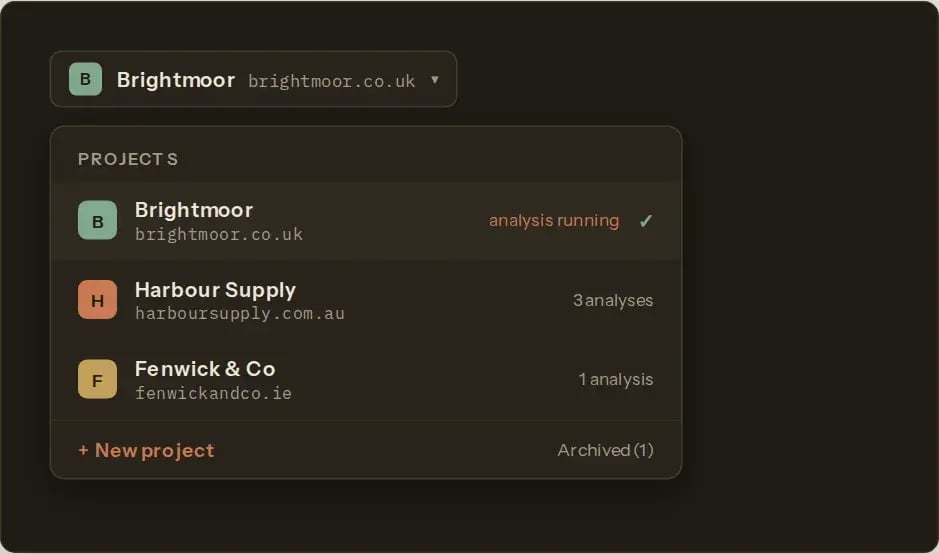
Real screen with sample data. All three clients are fictional.
“We have forty clients and no time to research each one properly.”
Mary does the reading for every client, not just the big ones. Your strategists start each client conversation from evidence, and spend their time on the advice.

One-session client onboarding
What happens in a new client’s first session?
From one web address to a report you can send. Discovery starts with the evidence already gathered, so your first conversation with the client is about what Mary found.
- 1
Web address
The client’s site, and nothing else.
- 2
Company profile
Who they are and who they sell to, every line labeled.
- 3
Personas
Several per client, each graded on its evidence.
- 4
Health check
Around 60 technical SEO checks on every page read.
- 5
Report to send
Sources included, in your branding (coming later).
Illustrative cards with sample data
Deliverables with the sources attached
What do you say when a client asks “where did you get that?”
You show them. Every claim in a client’s profile answers for itself: stated on their website, worked out from it, corrected or added by your team, or inferred. Quotes are pulled from the stored page and checked, never written.
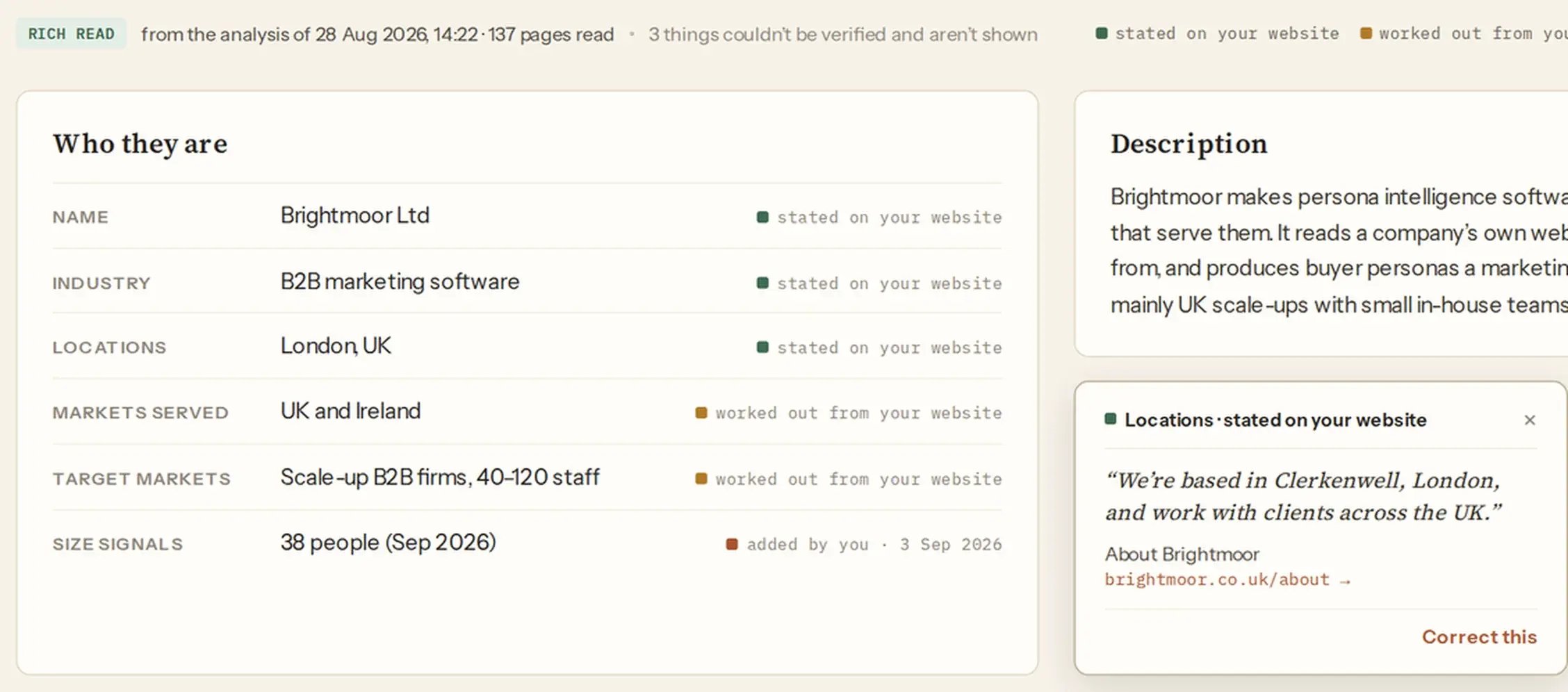
Real screen with sample data
Many clients, one workspace
How do you keep every client’s work in one place?
Each client is its own project, one per website. The project keeps every analysis of that site, so you can compare this quarter’s reading with the last. A project can’t run two analyses at once, so work is never duplicated.
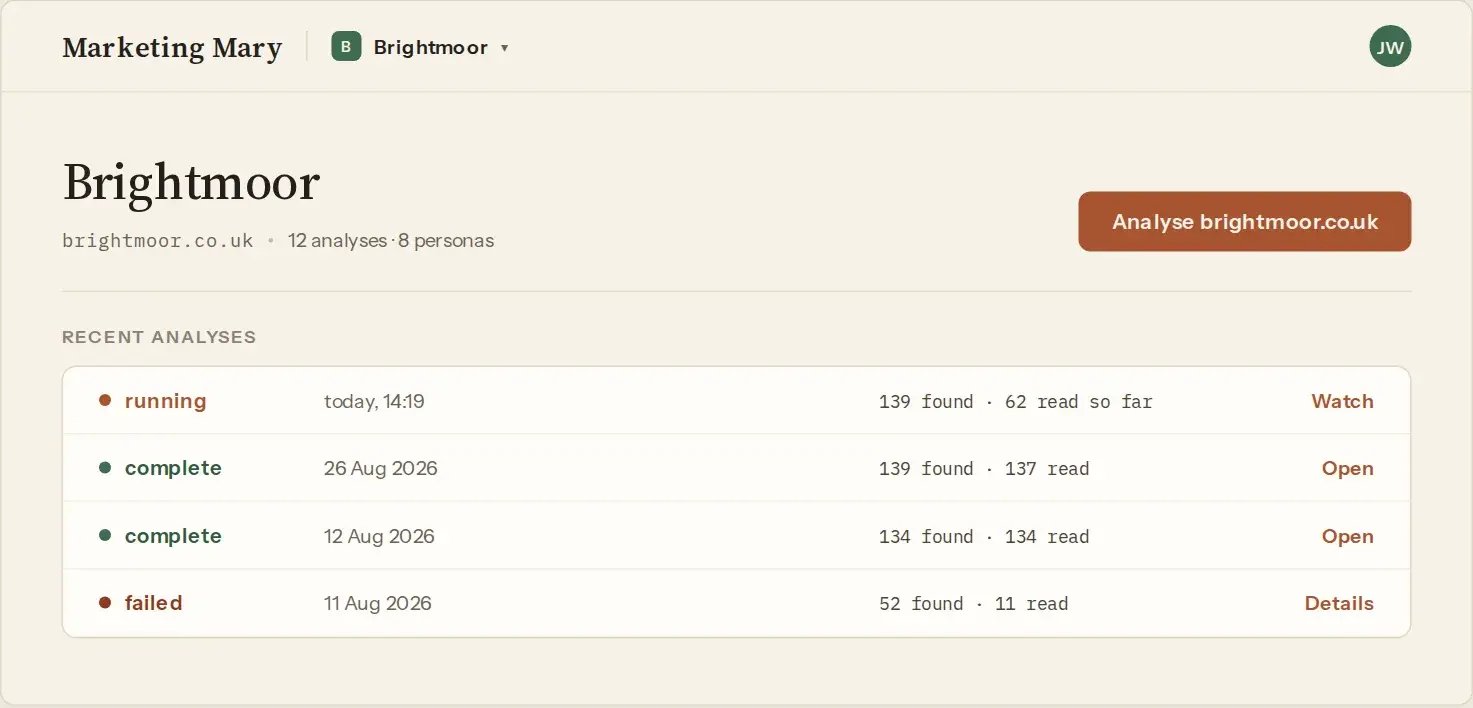
Real screen with sample data
Can Mary write in each client’s voice?
Yes, and voices don’t mix. Mary proposes a brand identity for each client from their website, and your team accepts or edits it before she writes anything. Each client gets a 90-day plan (coming later) sized to the hours on the account, and every piece waits for a named person on your team to approve it.
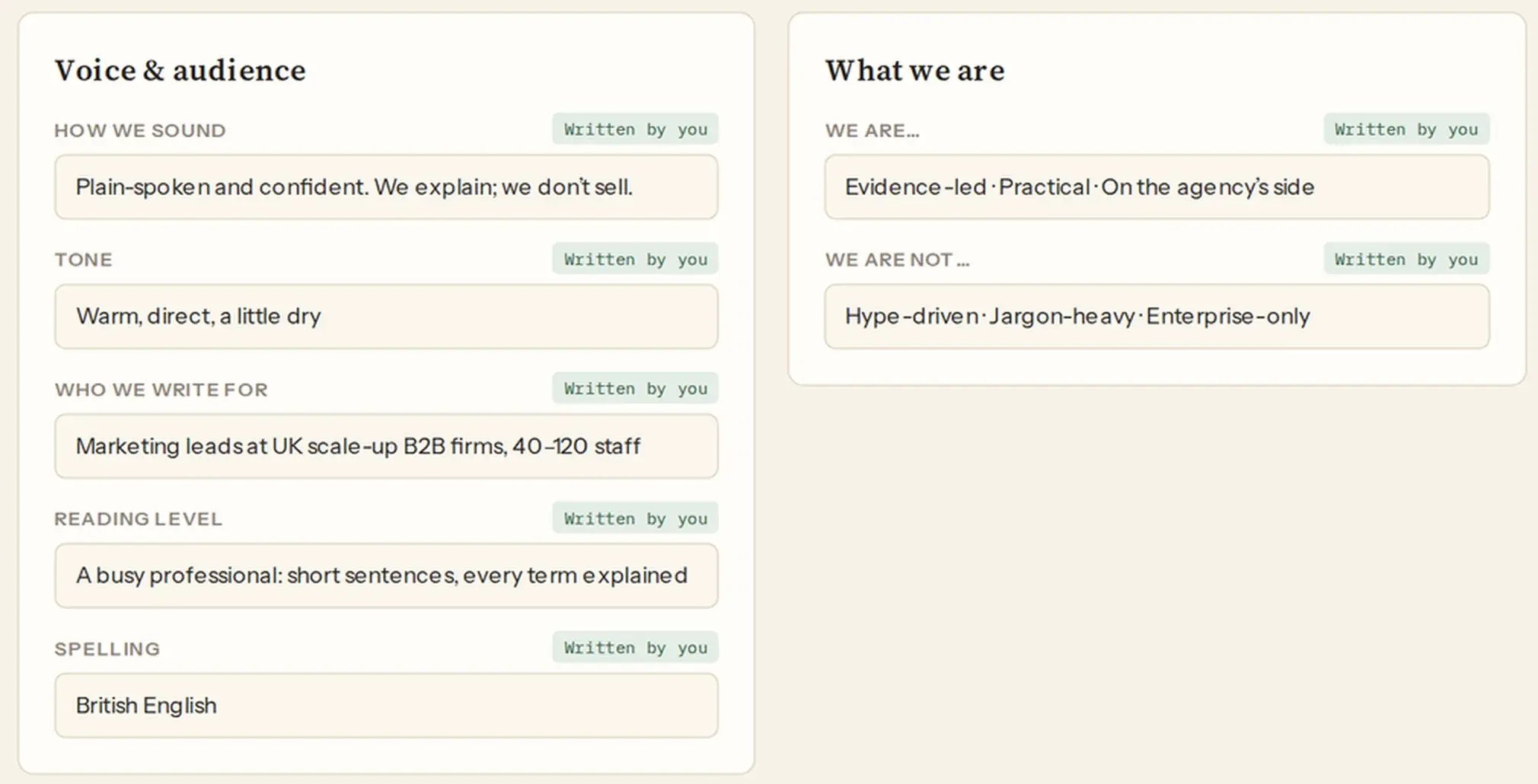
Real screens with sample data
Custom branding
Coming laterCan reports go out under our brand?
Not yet. Custom branding is coming later. You’ll be able to send client reports with your agency’s logo and colors, with the evidence still attached, so the work your client sees is work your team can stand behind.
When the report is about the client’s own brand, you’ll be able to use the client’s colors on headings and accents instead.
Report outline · illustrative card with sample data
Mary makes your strategists better. She doesn’t replace them.
Mary does the reading. Your team decides.
Clients still need the judgment, the relationship and the recommendation. Mary does the reading behind it and shows her sources, so your strategists start each client conversation from evidence and spend their time on the advice.
Marketing Mary grew out of the way we work with clients at a B2B marketing agency. Agencies use it for their client work, and so do we.
Which plan fits an agency?
Enterprise is built for agencies. Smaller agencies can start on Professional.
Every plan has a monthly allowance for reading and analysis. It’s checked before any work starts, with a warning as you approach the limit, so you can plan each client’s work against it and there are no surprise overruns.
- Each organization’s data is kept separate, and that separation is tested automatically on every change.
- HubSpot integration in the first release. WordPress publishing is coming later.
Professional
For smaller agencies starting with a handful of clients.
Pricing to be confirmed
Enterprise
For agencies running many clients.
- Many client projects
- Reports in your branding (coming later)
- Higher allowances
Pricing to be confirmed
Questions agencies ask
Will clients think they don’t need us?
Marketing Mary is built to make your agency’s work better and easier to defend, not to replace your strategists. Mary does the reading and shows her sources; your team brings the judgment, the relationship and the recommendation.
How do you keep one client’s data apart from another’s?
Each client is its own project, one per website, with its own brand identity, personas and content. Each organization’s data is kept separate, and that separation is tested automatically on every change. Where customer data is hosted will be confirmed before launch and set out in our data processing agreement.
Does it work with HubSpot?
Yes. HubSpot integration is part of the first release. WordPress publishing is coming later. Mary can read any client’s public website, whatever it runs on.
Can we send reports under our own branding?
Not yet. Custom branding is coming later. You’ll be able to send client reports with your agency’s logo and colors, with every source still attached. Reports download as a web page, Markdown or a print-ready PDF.
How does pricing work for many clients?
Enterprise is the plan for agencies, and smaller agencies can start on Professional. Pricing is to be confirmed. Each plan has a monthly allowance that’s checked before any work starts, with a warning as you approach the limit, so there are no surprise overruns.
What do we get when we onboard a new client?
From one web address: the site read with a full page table, a company profile with every line labeled by its source, evidence-graded personas, around 60 technical SEO checks on every page read, and a report with the sources included.
Start with one client.
Join the early-adopter list and be one of the first agencies to give Mary a client’s web address.