

What Is an AI Marketing Agent? (And Why It's Not Just Another Chatbot)
What Is an AI Marketing Agent? An AI marketing agent is an autonomous software system that perceives market data, reasons through complex workflows,...
11 min read
Clwyd Probert
:
Updated on March 24, 2026
An AI marketing agent is an autonomous software system that perceives market data, reasons through complex workflows, plans multi-step campaigns, executes actions across marketing platforms, and learns from outcomes — all without requiring continuous human prompting. Unlike chatbots that respond to individual queries or traditional automation that follows rigid if-then rules, AI marketing agents operate independently in the background, making decisions based on real-time conditions and adjusting their approach as circumstances evolve.
The distinction matters because it determines whether your technology investment drives marginal productivity improvement or transformational business impact. According to McKinsey's 2025 State of AI survey, 88% of organisations now use AI in at least one business function — yet only 6% qualify as "AI high performers" demonstrating measurable 5%+ EBIT impact. The gap between adoption and results comes down to one thing: whether organisations deploy AI as a tool (requiring constant human direction) or as an agent (operating autonomously toward defined goals).
Key Takeaway
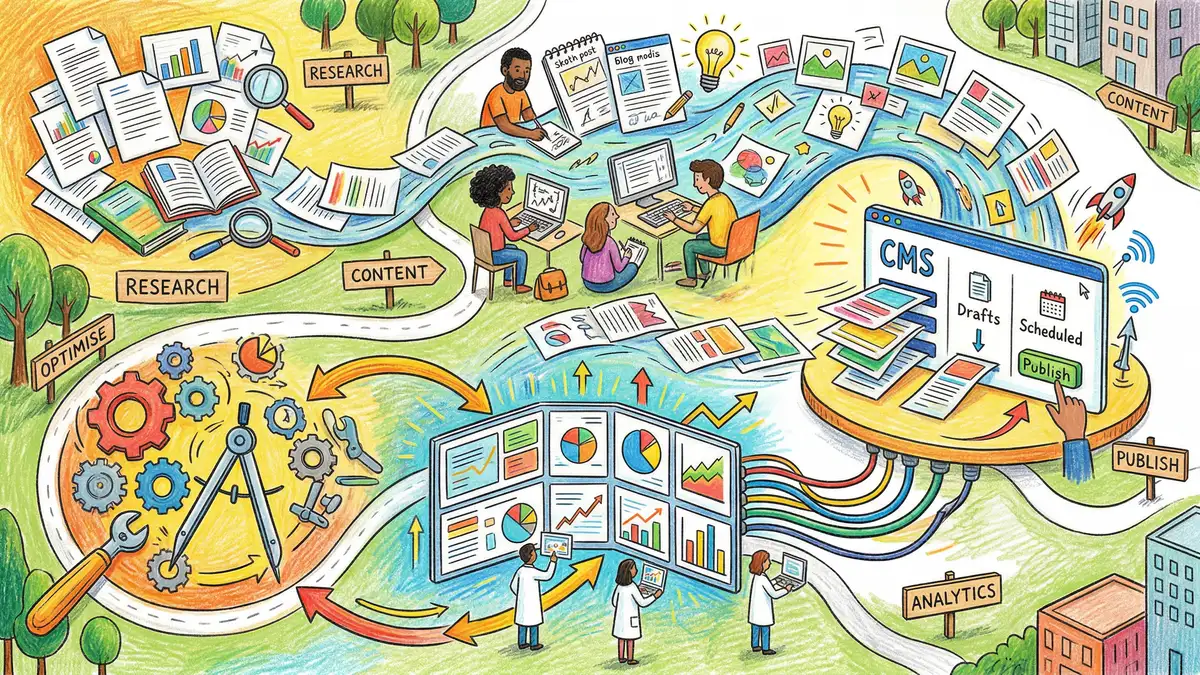
AI marketing agents don't just recommend actions — they execute them autonomously. They research markets, create content, publish to your CMS, monitor performance, and optimise campaigns without waiting for human approval at every step. This is the shift from "tools that assist" to "agents that execute."
The marketing technology industry uses "AI" to describe everything from simple email personalisation to fully autonomous campaign execution. But there are fundamental architectural differences between the three categories of AI marketing systems — and understanding them prevents expensive mistakes when evaluating platforms.
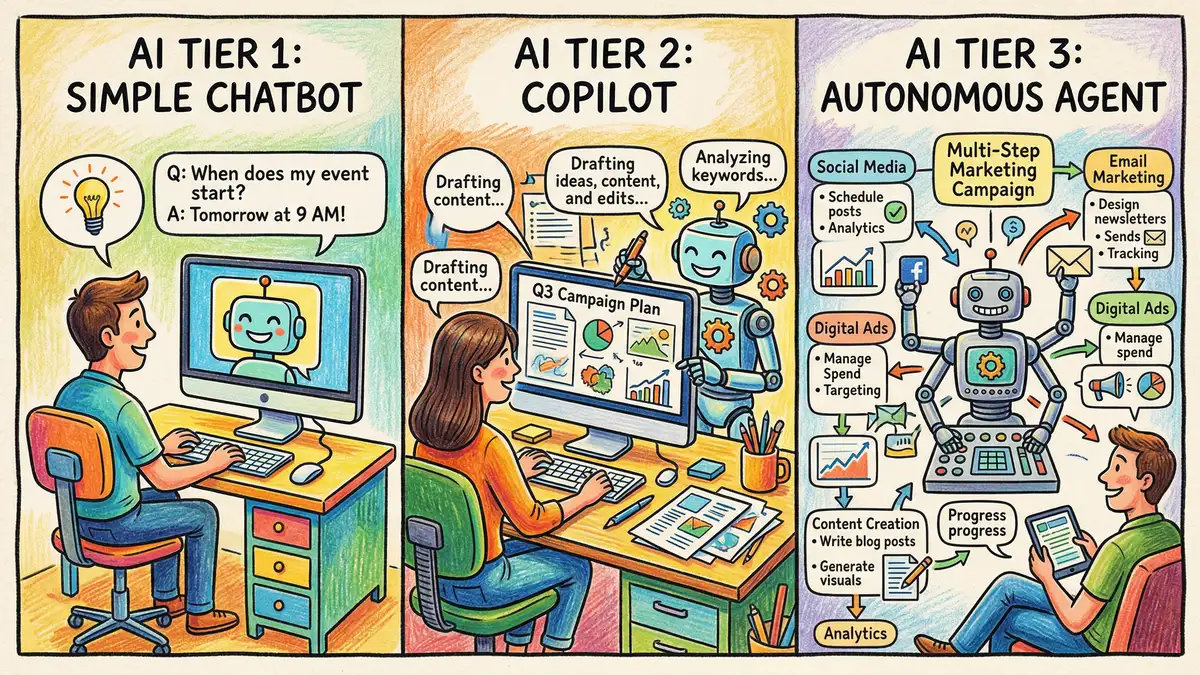
Celonis defines the distinction through a capability hierarchy grounded in practitioner experience. An AI assistant analyses data and makes recommendations — identifying underperforming campaigns, ranking suggested optimisations by potential impact, advising which changes should come first. But assistants cannot execute those recommendations. They're diagnostic tools requiring you to implement their suggestions manually.
An AI copilot takes the next step: it can execute the recommendations it formulates. A copilot might evaluate which ad creative performs best, compare alternative targeting approaches, and even deploy the winning variation. However, copilots operate within boundaries — they handle simple tasks and typically require continuous prompting rather than running independently in the background.
An AI agent represents a third category entirely. Agents reason through complex business problems, create multi-step plans, and execute each action sequentially — accounting for outcomes of previous steps. They operate independently without constant prompting, make decisions based on perceived conditions, and critically, they improve themselves over time, progressively learning your unique business needs.
| Capability | AI Assistant | AI Copilot | AI Agent |
|---|---|---|---|
| Analyses data | Yes | Yes | Yes |
| Recommends actions | Yes | Yes | Yes |
| Executes tasks | No | Simple tasks only | Complex multi-step workflows |
| Runs independently | No — waits for prompts | Partially — needs direction | Yes — operates in background |
| Learns and improves | No | Limited | Yes — continuous self-improvement |
| Handles complexity | Analysis only | Single-step actions | Multi-step, context-aware workflows |
Source: Celonis AI Framework 2025
The practical implication: when a marketing tool calls itself "AI-powered," ask whether it analyses, recommends, executes, or all three. Most tools stop at recommendation. True AI marketing agents — the kind that reshape how marketing teams operate — go all the way through to autonomous execution and continuous learning.

Marketing Mary's analysis of current AI marketing platforms reveals five capabilities that distinguish genuine AI marketing agents from AI-enhanced traditional tools. No single platform currently delivers all five — which is precisely why Marketing Mary was built to close that gap.
Autonomous Research
True agents independently research markets, competitors, and customer intent signals without requiring human initiation for each analysis cycle. They monitor competitor pricing changes, content velocity, keyword movements, and feature launches continuously — distinguishing strategic signals from noise and triggering alerts when significant changes warrant attention. This capability alone automates 90% of traditional competitive analysis workflow.
Brand-Voice-Preserving Content Creation
Generic AI content receives 5.44x less traffic than human-authored content. True agents embed your brand voice, messaging pillars, audience nuance, and product positioning directly into how they make content decisions — not as a post-execution filter, but as the operating framework. Brands with distinctive AI-maintained personalities see 20% higher customer retention.
CMS Integration for Direct Publishing
Most AI writing tools stop at generating a draft. True agents research topics, create content, apply SEO optimisation, publish directly with metadata and schema markup, add internal links, and schedule distribution — without human intervention for routine content. This transforms content operations from labour-intensive publishing to autonomous execution.
Performance Monitoring with Intelligent Alerting
Rather than requiring manual dashboard reviews, agents continuously track conversion rates, acquisition costs, engagement metrics, and revenue attribution — flagging deviations and recommending corrective actions in real time. This reclaims analyst capacity for strategic work rather than routine monitoring.
Iterative Optimisation
The most sophisticated capability: agents that continuously refine their strategies based on performance outcomes. Rather than following static rules, advanced agents learn which messaging, targeting, and content approaches drive results for your specific segments — creating self-reinforcing improvement loops that compound over time.
The marketing technology landscape has reached 15,384 distinct solutions — a 100x increase since 2011. Many now claim "AI agent" capabilities, but mapping them against the five-capability framework reveals significant gaps between marketing claims and actual agentic functionality.
| Platform | Autonomous Research | Brand-Voice Content | CMS Publishing | Performance Monitoring | Iterative Optimisation |
|---|---|---|---|---|---|
| ChatGPT | Partial | No | No | No | No |
| HubSpot Breeze | Yes | Yes | HubSpot only | Yes | Limited |
| Jasper Agents | Limited | Yes | Partial | Limited | Limited |
| Salesforce Einstein | Yes | Partial | Salesforce only | Yes | Yes |
| Albert.ai | Paid media only | No | No | Yes | Yes |
| Demandbase | Yes | Partial | No | Yes | Yes |
| Marketing Mary | Yes | Yes | Yes — HubSpot + more | Yes | Yes |
Sources: HubSpot Breeze AI 2025, Jasper Agents 2025, Marketing Mary platform analysis 2026
The pattern is clear: most platforms excel within specific domains — HubSpot dominates CRM integration, Albert.ai excels in autonomous ad optimisation, Jasper focuses on content creation with brand governance. But orchestrating a truly autonomous agent handling the complete workflow from research through publishing through performance monitoring remains fragmented across multiple point solutions.
Marketing Mary's AI Co-Pilot platform was purpose-built to close this gap: autonomous deep research, brand-voice content creation, direct CMS publishing with schema markup and internal linking, performance monitoring via Google Search Console integration, and iterative content optimisation based on real ranking data. It's the only platform that delivers all five capabilities in a single, unified workflow.

The financial case for true AI marketing agents over conventional AI tools isn't theoretical — it's backed by hard economics that UK SME marketing leaders can calculate against their own spend.
$5.44
Return per $1
Marketing automation ROI over 3 years
34%
Revenue Increase
Average for automation adopters
8+ hrs
Weekly Time Saved
Per marketer with stack unification
£250K
Annual Waste
From 12+ disconnected tools
Sources: SAP Engagement Cloud / The CMO Survey 2025, Marketing Mary persona research 2026
Every $1 invested in marketing automation returns $5.44 over three years, according to research from The CMO Survey and SAP. Companies deploying automation save an average of 2.3 hours per campaign and see 34% average revenue increases. But here's the critical nuance: these returns assume proper integration and autonomous execution. Teams using AI tools that still require constant human prompting, manual publishing, and disconnected analytics capture only a fraction of this potential.
The average UK SME marketing team uses 12+ tools, wasting £250K per year on redundant subscriptions, broken integrations, and the 8+ hours per week each marketer loses to manual data reconciliation between platforms. An AI marketing agent that unifies research, content creation, publishing, and performance monitoring into a single workflow doesn't just save tool costs — it eliminates the integration tax that prevents your existing tools from delivering their promised ROI.
See how Marketing Mary's AI Marketing Agent unifies your entire content workflow — from research to published, optimised content.
Explore the PlatformIndustry analysts agree: AI agents aren't a future possibility — they're the defining competitive infrastructure of the next 24 months. The predictions from Gartner, Forrester, and McKinsey paint a consistent picture of rapid transformation with high stakes for late adopters.
Gartner predicts that by 2028, organisations leveraging multi-agent AI for 80% of customer-facing processes will dominate their competitive landscape. Even more striking, Gartner forecasts that 90% of B2B buying will be AI agent-intermediated by 2028, with over $15 trillion in B2B spend flowing through AI agent exchanges. This means your future customers' AI agents will evaluate your content, compare your offerings, and make purchase recommendations — all without a human ever visiting your website.
Forrester anticipates that by 2027, GenAI and AI agents will create the first true challenge to mainstream productivity tools in 35 years, prompting a $58 billion market shake-up. The cost-to-value gap in process-centric service contracts will shrink by at least 50% as agentic AI replaces human-managed workflows with adaptive autonomous systems.
The Cautionary Data Point
40% of agentic AI projects will fail through 2027 due to escalating costs, unclear business value, or insufficient risk controls, according to Gartner. The organisations that succeed will be those treating agent deployment as transformational change — not incremental technology adoption.
The implication: Starting now with a proven, integrated platform beats attempting to build custom agent infrastructure from scratch. Marketing Mary's pre-built pipeline eliminates the integration complexity that kills 40% of DIY agent projects.
McKinsey's research adds crucial context: 62% of organisations are now at least experimenting with AI agents, but only 6% qualify as high performers. Those high performers share three characteristics — they set efficiency, growth, and innovation as simultaneous objectives; they redesign workflows rather than layering AI onto existing processes; and they're three times more likely to report scaling agent deployment across multiple business functions.
UK and EU marketing teams deploying AI agents face a regulatory landscape that creates both constraints and competitive advantages for compliant implementations. Understanding these requirements isn't optional — it's a business necessity that shapes which platforms you can safely deploy.
The UK Data Use and Access Act 2025 (DUAA) updates data protection law with significant implications for AI marketing agents. The DUAA clarifies automated decision-making provisions, opening the full range of lawful bases for processing personal information in significant automated decisions — subject to safeguards. This is directly relevant to AI agents making decisions about customer segmentation, next-best-offer selection, and campaign personalisation.
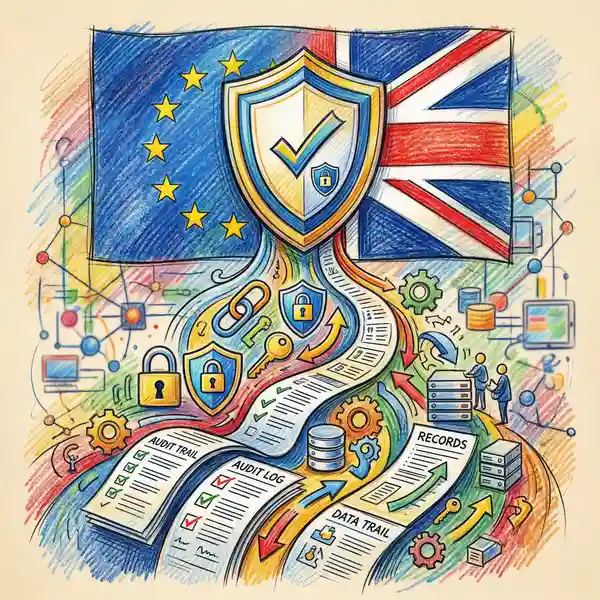
The EU AI Act, enforced since June 2025, governs AI agents through risk assessment, transparency tools, technical deployment controls, and human oversight design requirements. High-risk AI systems must maintain audit trails documenting which customers received which offers, through which channels, based on which data signals. Marketing AI agents processing customer data at scale must demonstrate compliance across all four pillars.
UK Advantage
The DUAA's "soft opt-in" provisions and clarification that direct marketing constitutes legitimate interest streamline AI-driven remarketing workflows. UK-built AI agents designed for this regulatory environment face fewer deployment barriers than platforms built for less regulated markets.
EU Compliance Requirement
Any AI agent marketing to EU customers must conduct impact assessments, document compliance measures, implement governance frameworks, and maintain audit capability. Choosing a platform with built-in compliance infrastructure eliminates significant implementation burden.
Marketing Mary is built in London with UK/EU GDPR compliance at the infrastructure level — not bolted on as an afterthought. For UK SME marketing teams, this means deploying an AI marketing agent without the regulatory risk that comes from using platforms designed for less regulated markets.

Research from Gartner, Forrester, and McKinsey identifies four failure modes that derail AI agent implementations. Recognising them upfront prevents the 40% failure rate that plagues organisations deploying agents without proper preparation.
Mistake 1: Instruction bloat. Teams attempt to handle every edge case through longer and longer instruction sets. This fails because agents operate through probabilistic models that struggle with highly detailed conditional logic. The fix: define 3–5 core operating principles and let agents learn through feedback rather than exhaustive rules.
Mistake 2: Integration complexity. AI agents require seamless integration with your CRM, marketing automation, analytics, and CMS. Legacy stacks with incomplete APIs, proprietary data formats, and inadequate real-time data flows constrain agent capability to isolated workflows. The fix: start with platforms offering native integrations (HubSpot ecosystem, Salesforce-native) before attempting multi-vendor orchestration.
Mistake 3: No governance framework. Agents optimising narrow metrics without guardrails produce unintended consequences — ad spend concentrated on a single segment, content that drifts from brand voice, customer interactions that feel inconsistent. DataRobot research finds that organisations implementing weekly compliance audits catch problematic agent drift far earlier than those conducting quarterly reviews.
Mistake 4: Poor data quality. AI agents are only as effective as the data feeding them. Inconsistent customer records, contradictory field definitions across systems, and high rates of missing data enable agents to make poor decisions. Audit your data before deploying agents — not after.
The Bottom Line
Organisations with strong change management programmes are 6x more likely to succeed in AI implementation (Forrester). The technology exists — the challenge is organisational readiness. Start with high-impact, low-risk use cases. Build confidence. Then expand.
The practical pathway to AI agent adoption isn't about attempting comprehensive transformation overnight. McKinsey's high performers — the 6% delivering measurable EBIT impact — share a common approach: begin with narrowly scoped, high-impact use cases that build organisational competency before expanding.
For UK SME marketing teams with 50–500 employees, Marketing Mary recommends a phased approach grounded in the research:
Month 1–3: Foundation. Audit your current marketing stack — how many tools, what's the integration quality, where are the data gaps? Establish baseline metrics for content production time, cost per piece, and organic traffic. Deploy Marketing Mary's AI Co-Pilot for your first use case: automated content creation from research through published, optimised blog post. This single workflow demonstrates agent capability while delivering immediate, measurable value.
Month 4–6: Expansion. Extend agent capabilities to buyer persona interaction — use Marketing Mary's real-time persona conversations to test messaging, uncover objections, and validate campaign angles before committing budget. Add performance monitoring to track which content drives pipeline and which needs optimisation.
Month 7–12: Scale. With proven workflows and measured results, expand across your full content calendar. Enable iterative optimisation where Marketing Mary automatically identifies underperforming content, refreshes it with updated research and improved structure, and republishes — creating a self-improving content engine that compounds results over time.
The research is clear: marketing leaders beginning agent implementation in 2026 will establish capability foundations enabling 2028 competitive advantage. Those who wait face accelerated competitive displacement as Gartner's multi-agent AI prediction becomes reality. The investment timeline typically spans 12–18 months from initial deployment to measurable ROI — which means starting now is the only way to be ready when the market shifts.
Is an AI marketing agent the same as marketing automation?
No. Traditional marketing automation follows rigid if-then rules — send this email when someone downloads that ebook. An AI marketing agent perceives market conditions, reasons through options, plans multi-step responses, and adapts its approach based on outcomes. Marketing automation sends predetermined messages at fixed intervals regardless of recipient behaviour; an AI agent notices that certain prospects engage more with video content on Tuesday mornings and automatically adjusts both content type and delivery timing.
How much does an AI marketing agent cost for an SME?
AI marketing agent pricing ranges from £39–£1,200+ per month depending on capability depth. Generic AI writing tools like Jasper start at £39/month but only cover content creation. Enterprise platforms like Salesforce Einstein exceed £1,200/month with complex implementation. Marketing Mary offers agency-quality capabilities at SaaS pricing (£99–£499/month), covering all five agent capabilities — autonomous research, brand-voice content, CMS publishing, performance monitoring, and iterative optimisation — in a single platform.
Will an AI marketing agent replace my marketing team?
AI marketing agents amplify your team — they don't replace it. The research shows that human-authored content still generates 5.44x more traffic than generic AI content. The winning formula: humans own strategy, brand voice, and creative direction. Agents handle research, execution, publishing, monitoring, and optimisation. Marketing Mary is built as a Co-Pilot, not a competitor — your team's expertise becomes the strategic direction that the agent executes at scale.
How long before an AI marketing agent delivers measurable ROI?
Research from Forrester and Boston Consulting Group indicates most enterprises see payback from workflow automation within 12–18 months, with ROI accelerating as AI systems mature and learn. However, Marketing Mary customers targeting content-led growth typically see first results faster — published, optimised content within hours of deployment, Google indexing within days, and ranking improvements within 60–90 days for low-competition keywords.
Is my data safe with an AI marketing agent?
Data safety depends entirely on which platform you choose. UK-built platforms like Marketing Mary are designed with UK GDPR and EU AI Act compliance at the infrastructure level. The UK Data Use and Access Act 2025 clarifies automated decision-making provisions and requires electronic complaint handling mechanisms. When evaluating platforms, verify where data is processed, what lawful bases support your use case, whether the platform maintains compliant audit trails, and whether human override capability exists for decisions affecting customer rights.
Can an AI marketing agent work with HubSpot?
Yes — and this integration matters because CMS publishing is one of the five capabilities that define a true agent. Marketing Mary integrates directly with HubSpot CMS, publishing complete blog posts with metadata, schema markup, featured images, internal links, and SEO optimisation — all without manual intervention. HubSpot's own Breeze Agents offer similar capabilities within the HubSpot ecosystem, though they're limited to HubSpot-native content management.
Ready to Deploy Your AI Marketing Agent?
Join 500+ marketing leaders already on the waitlist for Marketing Mary — the only AI marketing agent that covers all five capabilities: autonomous research, brand-voice content creation, direct CMS publishing, performance monitoring, and iterative optimisation.
Clwyd Probert
Founder, Marketing Mary
Clwyd Probert is the founder of Marketing Mary, an AI-powered marketing co-pilot platform, and CEO of Whitehat, a London-based SEO and inbound marketing agency and HubSpot Platinum Partner since 2016.
Sources: McKinsey State of AI 2025, Gartner AI Agent Predictions 2026, Celonis AI Framework 2025, EU AI Act 2025, UK Data Use and Access Act 2025, DataRobot Agent Performance 2025, SAP / CMO Survey 2025, Jasper Agents 2025, HubSpot Breeze AI 2025
What Is an AI Marketing Agent? An AI marketing agent is an autonomous software system that perceives market data, reasons through complex workflows,...
Your team is drowning in content requests. Sarah's spending 15 hours on a single blog post. Marcus is juggling approval workflows that sprawl...
The Complete Guide to Marketing Workflow Automation in 2026 Marketing teams are bleeding time. Between tool-switching, manual data transfers, and...