
What is an evidence-graded buyer persona?
 Clwyd Probert: Sep 30, 2026, 8:25:00 PM
An evidence-graded buyer persona is a buyer persona in which every claim carries a label saying where it came from: first-party evidence (the...
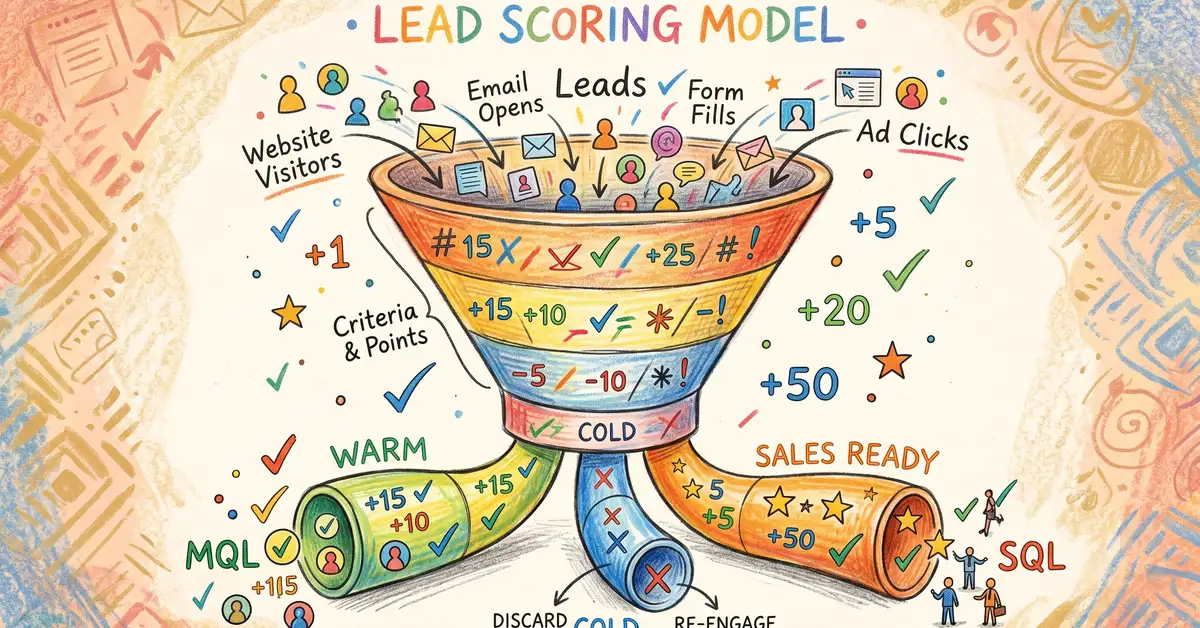
B2B organizations that implement lead scoring see a 77% increase in lead generation ROI compared with those without systematic scoring, according to Landbase's 2026 roundup of lead scoring statistics. Yet most B2B teams still route every inbound lead directly to sales — burning rep time on prospects who will never buy whilst high-intent buyers wait days for follow-up.
The solution is a scoring model that separates signal from noise. This guide walks you through building a custom lead scoring rubric with specific point values for demographic fit, behavioral intent, and disqualification signals — plus a free Excel template you can deploy in your CRM today.
Whether you are using HubSpot, Salesforce, or Marketo, the framework below gives your sales team a prioritized pipeline based on data, not gut feel.

Effective lead scoring operates on two independent dimensions. Demographic scoring evaluates whether a prospect matches your ideal customer profile — job title, company size, industry, geography, and budget authority. Behavioral scoring measures what a prospect actually does — pages visited, content downloaded, emails opened, demos requested.
The distinction matters because each dimension answers a different question. Demographic scoring asks: "Should we sell to this person?" Behavioral scoring asks: "Should we sell to this person right now?" You need both. A VP of Marketing at a 200-person SaaS company (high demographic fit) who has not visited your site in six months is not ready for sales outreach. Conversely, a student downloading every whitepaper you publish has zero purchase authority.
The two-dimensional approach also makes diagnostics straightforward. If high-scored leads are not converting, you can isolate the problem: is it demographic accuracy (wrong companies reaching sales) or behavioral weighting (engagement signals not predicting intent)?
The following framework is a starting point. Adapt the point values to match your sales team's actual qualification criteria.
Job title (decision-maker): +30 points — VP, Director, or Head of department scores 30. Manager-level scores 20. Individual contributors score 10.
Company size: +30 points — Companies with 50 to 500 employees score 30. Adjacent ranges (20-49 or 501-1000) score 15.
Industry alignment: +25 points — Primary target industry scores 25, adjacent industries score 15.
Demo or pricing request: +40 points — Strongest buying signal. Should always trigger immediate sales routing.
Pricing page visit: +30 points — Active evaluation. Prospect is comparing costs and considering purchase.
Case study download: +25 points — Building internal business case. Strong mid-funnel signal.
Content download: +15 points — Educational interest. Early-stage awareness, not purchase intent.
Competitor employee: -50 points — Researching, not buying. Remove from sales pipeline immediately.
Personal email in B2B: -25 points — Gmail or Yahoo in B2B context signals low authority.
Email unsubscribe: -25 points — Active disengagement. Prospect has rejected your communications.
Many organizations implement only positive scoring whilst ignoring factors that should disqualify a lead. Include negative signals to prevent score inflation.
Download our free Excel template with pre-built scoring rubrics for demographic, behavioral, and negative scoring factors. Includes threshold definitions, SLA recommendations, quarterly review KPIs, and GDPR notes for UK and EU contacts.
Download Free Lead Scoring Template (Excel)
Your scoring rubric is only useful if your CRM can act on it. Here is how the three major platforms handle lead scoring.
Native scoring via the HubSpot Score property. Pro plan includes rule-based scoring; Enterprise adds AI-powered predictive scoring. See HubSpot's lead scoring guide for setup details.
Einstein Lead Scoring provides predictive capabilities trained on your historical deal data — it needs a history of converted leads before it builds a model specific to your org. Strong for enterprise but complex for small businesses.
Built-in scoring via Smart Campaigns. Separate demographic and behavioral score fields by default — the only major platform with native two-dimensional scoring.
Regardless of platform, the implementation sequence is the same: define scoring criteria with sales, build rules, set threshold-based routing (75+ points triggers immediate sales alert), and establish a quarterly review cadence. If you are running marketing workflow automation, integrate scoring thresholds directly into lead routing workflows.
Warning: Don't Block Hand-Raisers. Any prospect who requests a demo, asks for pricing, or calls sales should bypass scoring thresholds and route immediately. Scoring informs prioritization — it should never create false gates that filter out genuine buyers.

A scoring model built today drifts as your market, products and buyers change. Teams that keep their models accurate do it through disciplined quarterly recalibration.
The quarterly review: compare highest-scored leads against closed-won deals. If fewer than 25% converted, adjust thresholds. Examine which factors correlated with wins. Check negative scoring. Validate score decay settings — halve behavioral points at six months, zero beyond twelve.
Four KPIs govern model health: MQL-to-SQL conversion rate by score tier, sales acceptance rate, average deal size by score tier, and pipeline velocity by score tier. Track monthly and recalibrate when any metric drifts more than 15% from baseline.

Lead scoring fails when marketing builds the model in isolation. The most common failure is misalignment between marketing's scoring criteria and sales' actual qualification standards.
Start by asking your sales team: "Of the last 20 deals we closed, what did those prospects have in common?" Build your initial model from those patterns, set thresholds jointly, and commit to a 90-day review.
Then operationalize the handoff. High-scored leads (75+ points) receive sales contact within one hour. Mid-scored leads (50-74 points) enter an accelerated nurture sequence. Below 50 points stays in marketing nurture. Configure your CRM to route leads automatically based on score via marketing workflow automation.
Start with 5-7 core criteria that best predict your conversions. Focus on job title, company size, industry alignment, and 3-4 high-intent behavioral signals. Add complexity only when data shows additional criteria improve prediction accuracy.
Rule-based scoring uses manually defined criteria and point values. Predictive scoring uses machine learning to analyze historical conversion data. Rule-based works for organizations with fewer than 500 leads. Predictive requires 500-1,000+ leads with outcomes.
Quarterly at minimum. Compare highest-scored leads against closed-won deals. Also recalibrate when launching new products or entering new markets. Models drift as your market and buyers change.
Yes, but start with rule-based scoring. Interview your salespeople about which characteristics they associate with successful deals. Even a simple 5-criteria model dramatically outperforms no scoring. Graduate to predictive models once you have 500+ leads with outcome data.
GDPR requires explicit consent before tracking behavioral signals. Design your model to function on demographic data alone for non-consenting prospects, with behavioral signals as enhancement for those who opt in.
Marketing Mary reads your website and builds evidence-graded buyer personas, so your scoring criteria start from evidence about who buys. Every claim shows where it came from.
Join the Marketing Mary early-adopter list
Sources: Landbase 2025, Verse.ai 2025, Prospeo 2026, HubSpot 2025
Clwyd Probert — Founder, Marketing Mary. Clwyd Probert is the founder of Marketing Mary, an evidence-first persona intelligence platform for B2B marketing, and CEO of Whitehat, a London-based SEO and inbound marketing agency and HubSpot Diamond Solutions Partner.
 Clwyd Probert: Sep 30, 2026, 8:25:00 PM
An evidence-graded buyer persona is a buyer persona in which every claim carries a label saying where it came from: first-party evidence (the...
 Clwyd Probert: Sep 9, 2026, 11:58:11 PM
Our own Search Console tells this story: impressions up 53% and clicks down 6% in the 28 days to September 6, 2026, compared with the 28 days before,...
 Clwyd Probert: Aug 25, 2026, 10:16:09 AM
You can find HubSpot's credit rates. You can find your monthly allowance. What you cannot easily find is the sentence that connects them — so most...
 Clwyd Probert : Apr 18, 2026, 11:00:00 AM
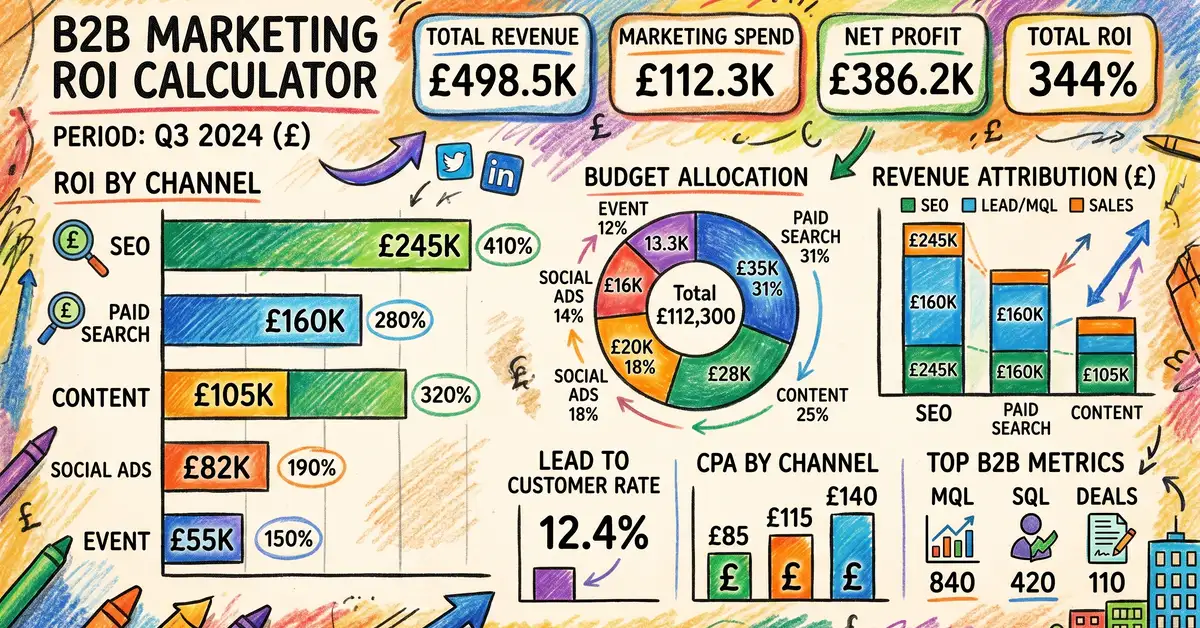
Free marketing ROI calculator with channel-specific formulas and B2B benchmarks. Downloadable Excel workbook with scenario models and attribution...
 Clwyd Probert : May 5, 2026, 11:00:00 AM
Run a complete MarTech stack audit in 5 steps. Free workbook scores utilization, integration, overlap and ROI clarity, and estimates license savings.
 Clwyd Probert : Mar 23, 2026, 12:00:00 PM
Five AI marketing workflows, from brief to reporting, with what to automate in each and where a person should approve.