
What is an evidence-graded buyer persona?
 Clwyd Probert: Sep 30, 2026, 8:25:00 PM
An evidence-graded buyer persona is a buyer persona in which every claim carries a label saying where it came from: first-party evidence (the...
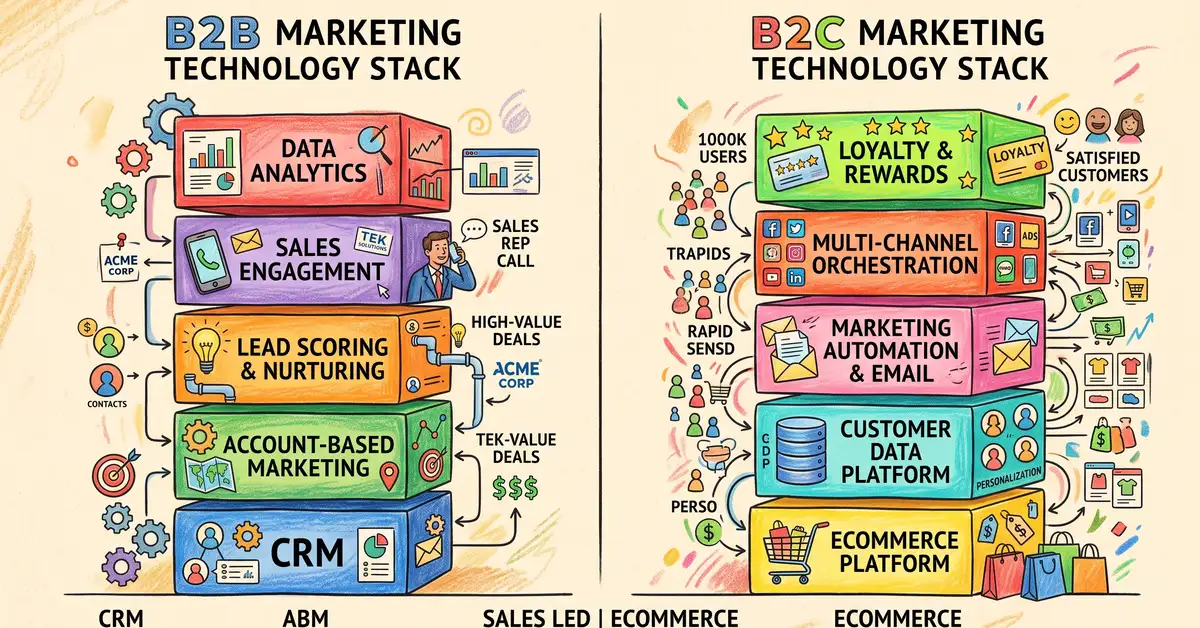
B2B and B2C MarTech stacks solve different problems. A B2B stack is built around the CRM to win a small number of high-value accounts over long, multi-stakeholder sales cycles. A B2C stack is built around a customer data platform to personalize high-volume, real-time journeys across large consumer audiences. The architecture, the tools and the budget split all follow from that one difference.
Copy a B2C playbook into a B2B team (or the reverse) and you end up paying for capability you never use. This guide maps the two architectures side by side — the center of the stack, the typical tools, the data each is built to handle, and how much of the marketing budget the technology tends to take — so you can build the stack your model actually needs. It's a companion to our complete guide to what a MarTech stack is.
Everything else follows from the data model. A B2B stack is organized around accounts, opportunities and deals — the CRM is the gravitational core, and roughly 42% of B2B stacks keep it firmly at the center. A B2C stack is organized around individual consumers, orders, baskets and behavioral events, so its center of gravity is shifting to a dual core of a customer data platform (or cloud data warehouse) plus a marketing-automation/engagement platform.
Put simply: B2B optimizes for revenue from a small number of high-value accounts; B2C optimizes for margin and lifetime value across large consumer populations in real time. Hold that distinction in mind and the tooling choices below are obvious.
A B2B stack layers specialist tools around the CRM to support long, multi-stakeholder buying cycles. The core layers:
Typical footprint: a CRM and a marketing automation platform at the core, with a small set of well-integrated specialist tools around them. Across all companies, martech took a mean 19.4% of marketing budgets in Gartner's 2026 CMO Spend Survey, a five-year low (Chief Marketer). If yours is heading higher, our MarTech stack audit template shows where the waste hides, and how to build a B2B stack that actually works covers the sequence.
A B2C stack is built to unify and activate high-volume behavioral data in real time. Its core layers:
Because B2C stacks must handle high-volume data, real-time personalization and multi-channel messaging, MarTech license spend tends to run higher, especially for the data platform plus engagement tools. Per-customer cost stays low because one platform serves millions of profiles.
| Aspect | B2B stack | B2C stack |
|---|---|---|
| Center of stack | CRM (Salesforce, HubSpot) | CDP / data warehouse + engagement platform |
| Primary data | Accounts, opportunities, lead scores, intent | Behavioral events, orders, baskets, LTV |
| Buying cycle | Long, multi-stakeholder, few high-value deals | Short, transactional, high-volume, repeat |
| Key tools | CRM, MAP, ABM/intent, sales engagement, attribution | CDP, ecommerce/DXP, engagement, personalization, loyalty |
| Personalization | Account-level, for named accounts | Individual-level, real-time offers |
| Typical tool count | Fewer, CRM-centered core tools | Broader on data/experience tools |
| MarTech share of budget | Lower: CRM-centered core | Often higher: data platform plus engagement |
Sources: emailvendorselection.com MarTech center-of-stack research (2026); HubSpot; Gartner via Chief Marketer.
Whichever model you run, the same failure mode applies: too many disconnected tools, only partly used. A Gartner survey found marketing leaders use only 33% of their martech stack's capability (2023). Both stacks need a clean data layer, tight integration and one place to run the work rather than a dozen dashboards. That's where an AI content tool earns its place: it runs the content work from research to an approved article, whichever architecture you've chosen.
Marketing Mary reads your website and builds evidence-graded buyer personas. Then it researches and drafts articles, and a named person approves every piece before it's published to HubSpot. After publishing, Marketing Mary adds internal links between your articles and checks the live page.
Join the early-adopter listStart from the shape of your revenue, not the tool logos. Three questions settle most of the architecture:
Then add only the layers that serve that answer. The most common and expensive mistake is buying a capability that belongs to the other model — a B2C-scale personalization engine for a 200-account B2B pipeline, or a heavyweight ABM platform for an ecommerce brand. Both show up in the audit as licenses nobody opens. Sequence the build (data foundation first, then activation) using our step-by-step guide to building a B2B MarTech stack, and pressure-test what you already own with the audit template.
The direction of travel in both camps is fewer, better-integrated tools. In B2B, the CRM has stayed stable at the center while marketing-automation platforms have retreated to a supporting role and teams trim overlapping point tools. In B2C, the single-vendor CDP is giving way to a dual core built on a cloud data warehouse plus an engagement platform, so the behavioral data lives in one governed place and activation happens on top.
The through-line is the same for both: the winners are not the teams with the biggest stacks, but the ones whose tools share clean data and a single operating layer. Whether your center of gravity is a CRM or a CDP, the job is to stop paying for capability you never activate and to give the team one place to run the work.
A B2B stack is built around the CRM to win a few high-value accounts over long sales cycles; a B2C stack is built around a customer data platform to personalize high-volume, real-time journeys for many individual consumers. The data model — accounts versus individuals — drives every other difference.
B2B keeps the CRM (Salesforce or HubSpot) at the center. B2C is moving to a dual core of a CDP or data warehouse plus an engagement/automation platform (such as Klaviyo or Braze), with the CRM playing a secondary role.
Gartner's 2026 CMO Spend Survey puts martech at a mean 19.4% of marketing budgets across all companies, a five-year low. B2C stacks tend to need more of that budget for the data-platform and engagement layers that real-time personalization at scale requires.
Some do — for example a B2B company with a self-serve product line. The practical approach is a shared data foundation with model-specific activation layers, kept unified by one operational layer rather than two parallel toolsets nobody fully uses.
Sources: Email Vendor Selection — CRM/MAP MarTech research 2026 · HubSpot — building a marketing stack · Gartner CMO Spend Survey 2026 via Chief Marketer · Marketing Mary — What is a MarTech stack
 Clwyd Probert: Sep 30, 2026, 8:25:00 PM
An evidence-graded buyer persona is a buyer persona in which every claim carries a label saying where it came from: first-party evidence (the...
 Clwyd Probert: Sep 9, 2026, 11:58:11 PM
Our own Search Console tells this story: impressions up 53% and clicks down 6% in the 28 days to September 6, 2026, compared with the 28 days before,...
 Clwyd Probert: Aug 25, 2026, 10:16:09 AM
You can find HubSpot's credit rates. You can find your monthly allowance. What you cannot easily find is the sentence that connects them — so most...
 Clwyd Probert : May 3, 2026, 11:00:00 AM
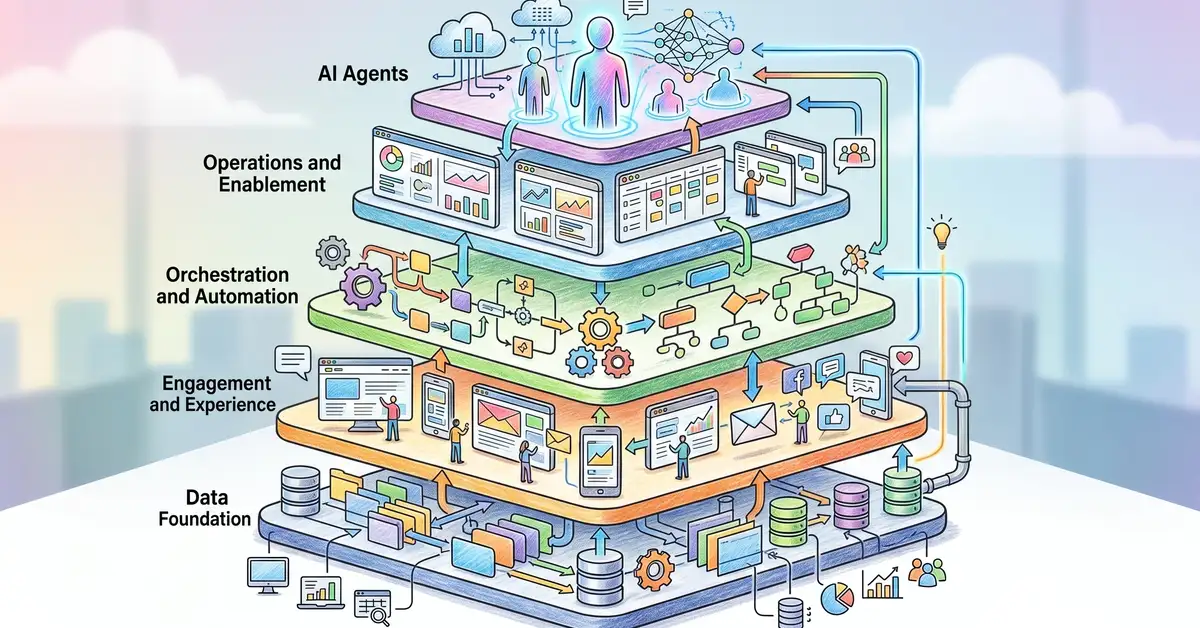
What a MarTech stack is, the 5 core layers, and how suite, best-of-breed and composable setups compare, with cost benchmarks for B2B marketing teams.
 Clwyd Probert : May 4, 2026, 11:00:00 AM
Learn the four-phase framework for building a B2B martech stack without tool sprawl, using a hub-and-spoke architecture.
 Clwyd Probert : Jul 26, 2026, 5:24:55 PM
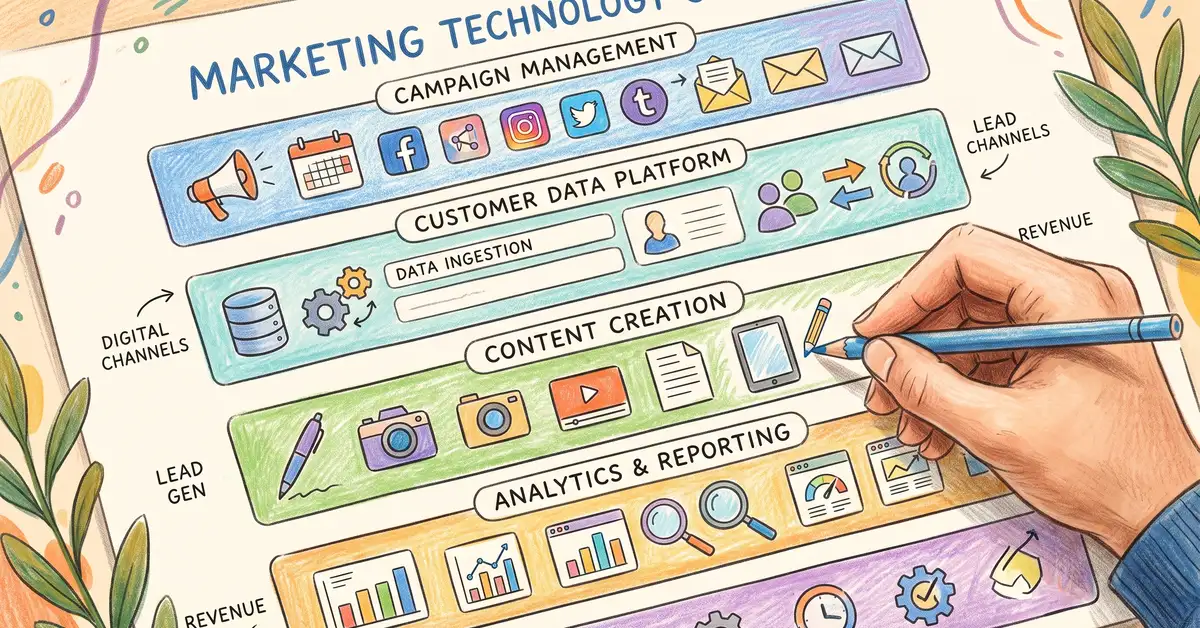
Free editable MarTech stack diagram template in PowerPoint. Map your marketing tools across six layers in 20 minutes and see overlap, gaps and wasted...