
Which AI Marketing Tools Integrate Natively With HubSpot?
Every AI marketing tool on the market claims to "integrate with HubSpot". Most of them mean something much smaller than you think, and you usually...
5 min read
Clwyd Probert
:
Updated on August 4, 2026
Every AI marketing tool on the market claims to "integrate with HubSpot". Most of them mean something much smaller than you think, and you usually discover the difference three weeks after the contract is signed, when the data you expected in your CRM is sitting somewhere else.
The short answer
Only Breeze, HubSpot's own AI, is genuinely native. It is built into the Smart CRM, reads and writes HubSpot objects directly, and needs no connector. Everything else falls into two much weaker categories: a small group of Marketplace apps with real two-way sync, and a very large group that is merely connected, usually pushing data one way through Zapier or an API. The word "integration" is doing a lot of work in that last group.
| Tier | What it means | Examples | What you can rely on |
|---|---|---|---|
| 1. Native | Built into HubSpot. Runs in the HubSpot interface on Smart CRM data. No connector exists because none is needed. | Breeze Assistant, Breeze Agents, Breeze Intelligence, AI workflow actions, HubSpot AEO | Full read and write access to CRM objects, in real time. |
| 2. Two-way sync | A Marketplace app that reads from and writes back to named HubSpot objects, including custom properties. | Heymarket, Google Sheets Connector, Stacksync, HubSpot-built Data Sync apps | Records stay aligned both ways, though the AI itself runs outside HubSpot. |
| 3. Connected | Data reaches HubSpot, usually one way, often via Zapier or a generic API call. The tool's logic and history live elsewhere. | Jasper, Grammarly, Drift, most social and analytics tools | Leads or drafts arrive. Little else does. |
HubSpot says more than 100 AI features are now embedded across the platform. The ones a marketing team will meet first sit under the Breeze name.
Breeze Assistant (previously Copilot) is the conversational layer inside the interface. It drafts emails, landing pages, blog posts and social copy using your own lists and brand settings, summarises records and calls, and will build workflows, lists and reports from a plain-English prompt.
Breeze Agents are task-specific and run on the Breeze Context Layer, which combines CRM data, content and conversations. The Content Agent writes and pushes straight into HubSpot pages, blog posts and email drafts. The Social Media Agent generates and schedules posts that log as HubSpot activities. The Prospecting Agent researches accounts and writes its findings back onto contact and company records. The Customer Agent answers questions in Conversations and updates tickets.
Breeze Intelligence enriches contacts and companies from a database of more than 200 million profiles, adds buyer-intent signals, and shortens forms by dropping fields it can already answer. Everything it produces lands in HubSpot properties.
HubSpot AEO, introduced at the Spring 2026 Spotlight, is the newest of these. It uses your CRM data to suggest the prompts real customers are likely to type into an LLM, which is a different job from keyword research and worth understanding on its own terms.
The test that settles it: if the feature is branded Breeze, or appears inside a HubSpot editor, workflow builder or record sidebar without you installing anything, it is native. If you had to visit the App Marketplace, it is not.
A small number of Marketplace apps do more than drop leads into your CRM. The marker to look for is a listing that names the HubSpot objects it syncs and uses the words bi-directional or two-way.
Heymarket is the clearest example on the messaging side. It is the highest-rated SMS app in the Marketplace at 4.7 stars, and it syncs Contacts, Companies, Deals, Tickets and Custom Objects in both directions, including custom properties. Inbound messages create contacts in HubSpot, conversations appear on the timeline, and you can reply from HubSpot Conversations while the data stays aligned.
On the data side, the Google Sheets Connector offers AI-powered two-way sync between HubSpot and a spreadsheet, and Stacksync provides real-time bi-directional sync between HubSpot and a database. Neither is a marketing tool in itself. Both matter because they let an external model work on mirrored CRM data and write scores or segments back where your team will actually see them.
A related group extends HubSpot Workflows with outside models. Apps such as AI Studio for Workflows and the ChatGPT workflow actions send record data to a model mid-workflow and write the output back into HubSpot properties or notes. Functionally that is a round trip, and for many teams it is enough.
This is the part vendors are quietest about, and it is worth saying plainly because these are good tools that are simply not what their integration pages imply.
None of that makes them poor choices. It does mean that if your reason for buying was "it plugs into HubSpot", you should check what plugs in, and in which direction.
If you are already on HubSpot, Breeze is the lowest-friction place to start, and for summarising records, drafting emails and enriching contacts it is hard to argue with something that is already in the room and already knows your data.
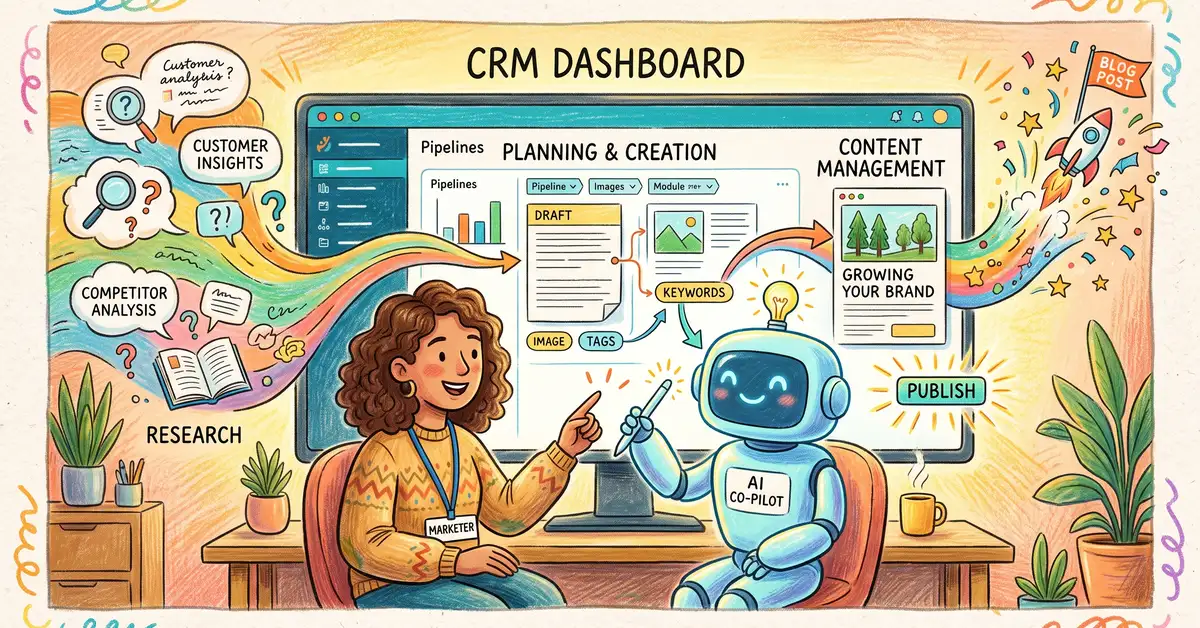
The gap most teams hit is the same one that shows up in every content pipeline. Drafting is one step of nine. Research, brand voice, images, SEO metadata, schema markup, publishing, internal linking and verification are the other eight, and they are where the week disappears. Marketing Mary is built to sit above HubSpot rather than replace any part of it, running all nine steps as a Co-Pilot so that Breeze keeps doing what it is good at and the operational tail stops landing on a person at four o'clock on a Friday.
If you want the mechanics of that, we have written up how an AI marketing Co-Pilot works inside HubSpot, and the difference between a co-pilot and an agent if you are still weighing up how much autonomy you want to hand over.
Is Breeze included in HubSpot or does it cost extra?
Breeze features are embedded across HubSpot subscriptions, but the heavier capabilities consume credits and some agents require particular tiers. Check your portal's credit allowance before you plan a workflow around it, because consumption is the constraint most teams meet first rather than availability.
Can I use ChatGPT or Claude with HubSpot data?
Yes, through workflow apps that pass record data to a model and write the response back, or through connector apps that mirror CRM data elsewhere. Neither is native in the Breeze sense, and both mean your data leaves HubSpot, which is a question for whoever owns data governance.
What is the difference between an integration and a native AI feature?
A native feature runs inside HubSpot on Smart CRM data with no installation step. An integration connects a separate product, and its usefulness depends entirely on how much moves back into HubSpot and how much stays on the other side.
Does Marketing Mary replace HubSpot Breeze?
No. It layers above Breeze and covers the steps Breeze does not, from research through to published and verified content. Teams keep HubSpot as the source of truth and use the Co-Pilot for the pipeline around it.
Breeze drafts. Something still has to publish.
Marketing Mary runs all nine steps of the content pipeline as a Co-Pilot alongside HubSpot, so the eight steps after the draft stop being someone's Friday afternoon.
Includes a free audit of your current stack. No card required.
Every AI marketing tool on the market claims to "integrate with HubSpot". Most of them mean something much smaller than you think, and you usually...
An AI marketing co-pilot works alongside a human who directs and signs off each step; an AI marketing agent works autonomously towards a goal with...
A MarTech stack diagram is a single-page map of every tool your marketing team runs, grouped into layers by the job each one does — data foundation,...
1 min read
Reviewed and updated July 2026. An AI marketing workflow, at a glance Trigger → Segment → AI drafts → Brand-voice check → Publish / send → Measure...
1 min read
An AI marketing co-pilot works alongside a human who directs and signs off each step; an AI marketing agent works autonomously towards a goal with...
1 min read
An AI marketing co-pilot is a platform that runs the full marketing content workflow — research, write, brand voice, images, SEO, schema, CMS...