
What is an evidence-graded buyer persona?
 Clwyd Probert: Sep 30, 2026, 8:25:00 PM
An evidence-graded buyer persona is a buyer persona in which every claim carries a label saying where it came from: first-party evidence (the...
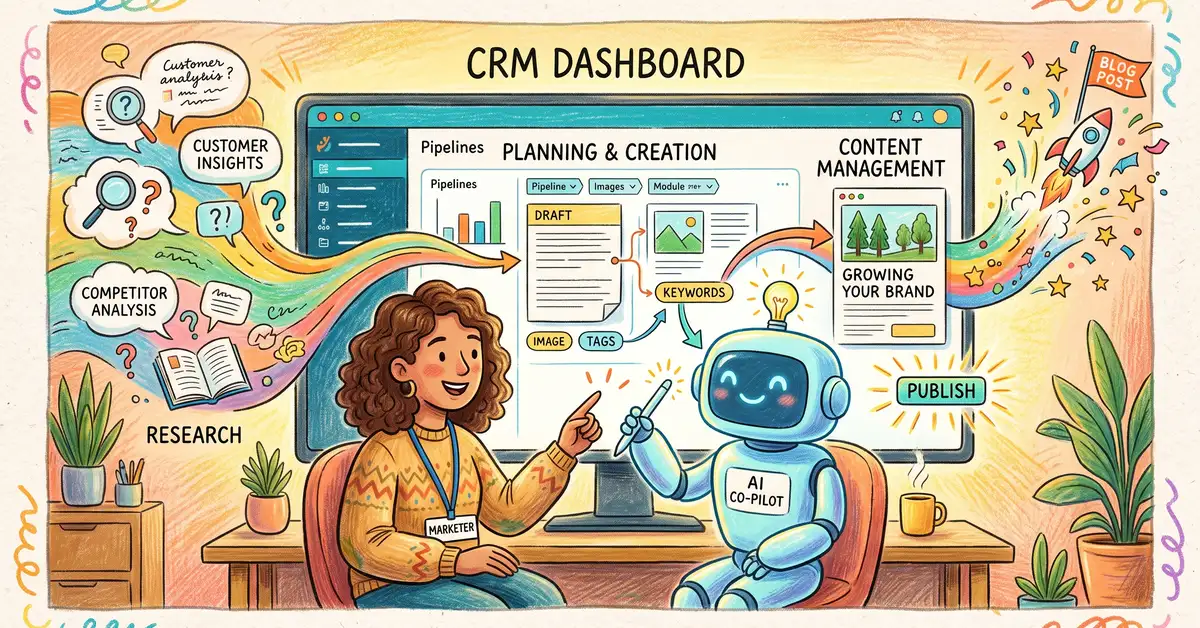
An AI marketing co-pilot is a platform that runs the full marketing content workflow — research, write, brand voice, images, SEO, schema, CMS publish, internal links, verification — alongside the marketing team rather than as a single-step generator. Inside HubSpot, a co-pilot connects to the portal API and works directly against the existing blog and CMS configuration.
Many B2B marketing teams run on HubSpot, and most of them are now asking the same question of ChatGPT, Perplexity and Google's AI Overviews before they ever reach a vendor's site: how does AI actually work inside HubSpot, and where does the built-in AI stop? This guide answers that end to end — what a co-pilot is, how it plugs into a portal, and exactly what it does on a single blog post.
An AI marketing co-pilot is a platform that runs the whole content workflow beside your team, not a chatbot that hands back a draft and leaves the rest to you. The distinction matters. Most "AI assistant" tools are one-shot generators: you prompt, they produce text, and a person still has to optimize it, add the images, write the metadata, mark up the schema, publish it, wire the internal links and check it went live correctly. A co-pilot owns that operational tail so the human keeps the judgment and the AI carries the work.
This is the "co-pilot, not autopilot" model, and the evidence supports it: 93% of businesses in Semrush's 2024 AI content study review their AI-generated content before publishing it (Semrush, 2024). A co-pilot is built around that reality.
Inside HubSpot, an AI marketing co-pilot connects to the portal via the CMS API using a portal-scoped credential. It reads the content group, blog, and author configuration; generates research-grounded drafts; applies the brand-voice ruleset; uploads images directly to the HubSpot file manager; injects Article and FAQPage schema; publishes through the standard blog endpoint; and runs a post-publish verification pass before declaring the article live.
In practice that means the co-pilot works with your portal exactly as it is configured — your blog, your authors, your content groups — rather than asking you to move content elsewhere and paste it back. Nothing is exported and re-imported by hand. The HubSpot connection is the layer that makes this possible, and it is the practical answer to the question your ops manager actually asks: "do we already have this in HubSpot, or is it a new system to run?" It is not a new system. It is a layer on the portal you already run.
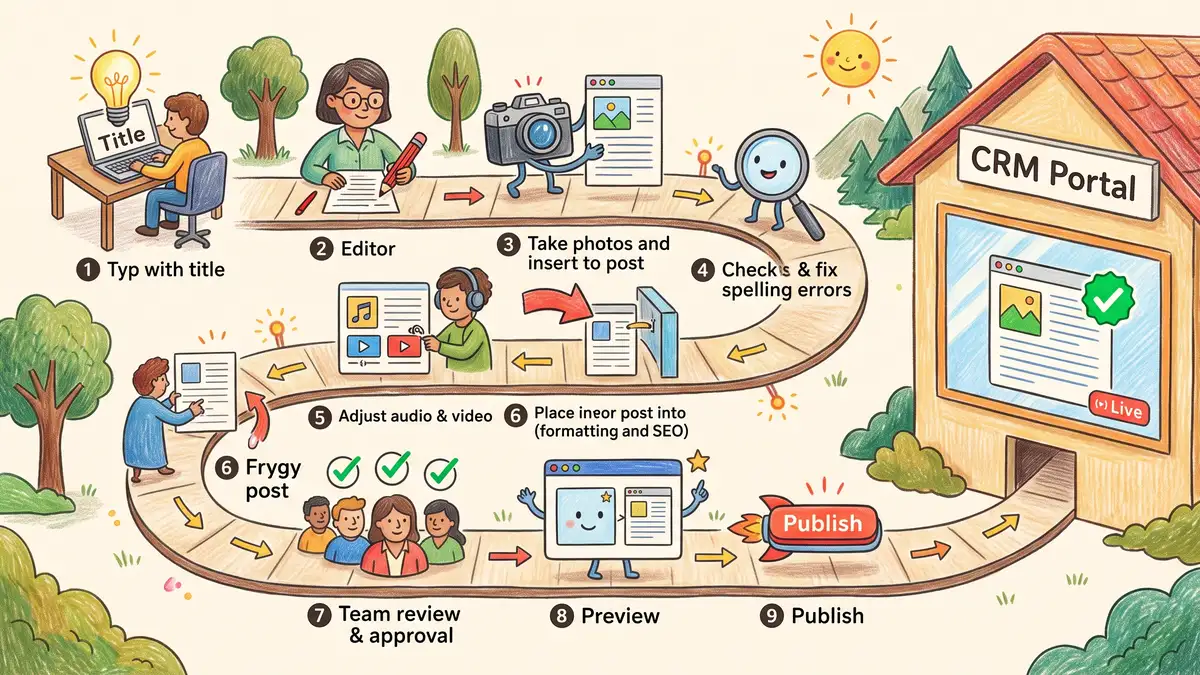
A concrete example makes it tangible. Say you want a post on "marketing attribution for B2B SaaS". The co-pilot researches the question and the competing answers, drafts the article, and applies your brand-voice ruleset so it reads like your team. It generates the images and uploads them to your HubSpot file manager, writes the title tag and meta description, and injects Article and FAQPage schema. It then publishes the post through the standard blog endpoint under your chosen author and content group, wires in links to your related posts, and finally runs a verification pass that confirms the page is live, the schema validates, and every image and link resolves. Your marketer briefed it and signed it off; the co-pilot did the nine steps in between. That is the difference between a tool that hands you a draft and a co-pilot that takes a brief to a verified, live page.
The terms get used interchangeably, but they describe different postures. An AI marketing agent implies autonomy — it goes off and does the task. A co-pilot implies partnership — it does the work while a human directs and signs off at each gate. For regulated, brand-sensitive B2B marketing, the co-pilot posture is the safer and more accurate one, because the human stays in command of voice, claims and final publish. If you want the fuller distinction, our guide to what an AI marketing agent is covers it in depth.
HubSpot Breeze handles roughly three of the nine pipeline steps — writing assistance, partial SEO, and native CMS publish. Marketing Mary handles the work around the draft. It researches first and writes to the brand identity you've approved. It adds images and produces a quality report that checks the structured data and every checkable claim. Then it publishes to HubSpot once a named person has approved the piece. After publishing, it adds internal links between your articles and checks the live page. Inside HubSpot, the two work together: Breeze stays for inline writing and native features, and Marketing Mary handles research, the quality check and approval before anything publishes.
| Pipeline step | HubSpot Breeze | Left to a person without another tool |
|---|---|---|
| 1. Research | Limited | Mostly |
| 2. Write | Yes | No |
| 3. Brand voice | Partial | Partly |
| 4. Images | No | Yes |
| 5. SEO metadata | Partial | Partly |
| 6. Schema markup | No | Yes |
| 7. CMS publish | Yes | No |
| 8. Internal links | No | Yes |
| 9. Verification | No | Yes |
By our reading of HubSpot's documentation, Breeze covers about three of these nine steps. See the fuller tool landscape in our AI blog writer tools comparison.
No. Marketing Mary augments HubSpot; it does not replace Breeze. Breeze stays for the parts it does well — inline writing assistance and native publishing inside the HubSpot editor. Marketing Mary sits alongside it and handles the research, brand identity, images and quality check that Breeze leaves to a person, then publishes to HubSpot once someone approves, adds internal links and checks the live page. The two are complementary, and keeping Breeze means you lose nothing by adding Marketing Mary alongside it.
Marketing Mary's HubSpot integration ships in the first release. Which HubSpot plans it supports will be confirmed at launch. For the marketing ops lead who owns the "will this fit our setup?" question, the practical boundary is simple: it publishes into the blog you already run, and it never asks you to restructure the portal to accommodate it.
Because the connection is scoped to the portal, the co-pilot reads and writes only what that credential permits, and every action is against your live configuration — the same content groups, authors and blog settings your team already uses. There is no parallel CMS to keep in sync. The point is to work inside the portal you already run, rather than adding another disconnected tool to your martech stack.

Here is the full sequence an AI marketing co-pilot can cover when it takes a single blog post live inside a HubSpot portal:
9 steps. One co-pilot. Inside HubSpot.
That is the category's full sequence. Marketing Mary's own sequence for a blog post puts a person in charge of publishing: it researches the question, drafts against the brand identity you've approved, adds images, and produces a quality report that checks the structured data and every checkable claim. A named person on your team reviews and approves the piece, and only then does Marketing Mary publish it to HubSpot (WordPress follows shortly after). After publishing, it adds internal links between your articles and checks the live page.
Quality is preserved by two mechanisms working together: a brand-voice ruleset applied at draft time, and a post-publish verification pass at the end. The ruleset enforces your terminology, tone and claims so nothing off-brand ships; verification confirms the page rendered correctly, the schema validates, and the links and images resolve. Between the two sits the human — reviewing, approving and scheduling. Nothing publishes unseen.
Yes, from Marketing Mary's first release, which includes the HubSpot integration. Here is what it does, in order: it reads your website, works out your personas, plans your content, and writes the articles (research, draft, images and a quality check). You review and approve each piece, and then it publishes to HubSpot, with WordPress following shortly after. Once a piece is live, it adds internal links between your articles and checks the live page. It connects to HubSpot with a portal-scoped credential, so its access is limited to the portal you connect. People on the early-adopter list will be among the first to use it. Marketing Mary is built to make your team's work go further, not to replace anyone. Pricing is to be confirmed. Deeper reading: the AI marketing automation guide and the HubSpot marketing automation guide.
Join the early-adopter list and be one of the first to try Mary on your own website.
Join the early-adopter listA platform that runs the full marketing content workflow — research, write, brand voice, images, SEO, schema, CMS publish, internal links, verification — alongside the marketing team rather than as a single-step generator. Inside HubSpot it connects to the portal API and executes those nine steps against your existing blog and CMS configuration.
Breeze covers about three of nine steps — writing assistance, partial SEO, and native publish. A co-pilot covers all nine, adding research, brand-voice enforcement, image generation, schema markup, internal-link wiring and post-publish verification. They work together; the co-pilot fills the seven steps Breeze leaves to a person.
No. It augments HubSpot and works alongside Breeze. Breeze stays for inline writing and native publishing; Marketing Mary adds research, a quality check and approval around it, plus internal links and a check of the live page after publishing. Keeping Breeze costs you nothing.
Marketing Mary's HubSpot integration ships in the first release. Which HubSpot plans it supports will be confirmed at launch. It publishes into the blog you already run.
A brand-voice ruleset is applied at draft time and a post-publish verification pass runs at the end, with a human reviewing, approving and scheduling in between. In Semrush's 2024 study, 93% of businesses review AI-generated content before publishing, and the co-pilot model is designed around that gate.
Yes. Marketing Mary has a Free plan; prices for the paid plans are to be confirmed. Join the early-adopter list to be among the first to use it.
Sources: Semrush AI content study, 2024 · Gartner 2026 (AI-leverage effect) · HubSpot CMS Blog API docs · Salesforce State of Marketing 2026
 Clwyd Probert: Sep 30, 2026, 8:25:00 PM
An evidence-graded buyer persona is a buyer persona in which every claim carries a label saying where it came from: first-party evidence (the...
 Clwyd Probert: Sep 9, 2026, 11:58:11 PM
Our own Search Console tells this story: impressions up 53% and clicks down 6% in the 28 days to September 6, 2026, compared with the 28 days before,...
 Clwyd Probert: Aug 25, 2026, 10:16:09 AM
You can find HubSpot's credit rates. You can find your monthly allowance. What you cannot easily find is the sentence that connects them — so most...
 Clwyd Probert : Jul 29, 2026, 8:29:40 AM
Co-pilot vs AI marketing agent: a co-pilot works with a human directing each step; an agent acts autonomously. The difference, a comparison table,...
 Clwyd Probert : Aug 4, 2026, 10:31:43 AM
Only Breeze is truly native. A small group of Marketplace apps have real two-way sync, and most tools are merely connected. The three tiers, with...
Clwyd Probert : Sep 9, 2026, 11:58:11 PM
AI Overviews cite many sources at one shared position and assistants fire queries no human types. Why Search Console impressions climb as clicks fall...