

9 min read

What Is a MarTech Stack? Complete Guide (+ Audit Template)

What Is a MarTech Stack? Complete Guide (+ Audit Template)

What Is a MarTech Stack?

A MarTech stack is the integrated collection of marketing technology platforms, data flows, and automation tools that a business uses to plan, execute, measure, and optimise its marketing activities. For B2B teams managing 50–500 employees, the typical MarTech stack spans 15–28 tools across CRM, marketing automation, analytics, content management, and advertising — costing £120,000–£350,000 annually when implementation, integration, and staff time are included. Marketing Mary's workflow integration platform unifies these fragmented tools into a single operational layer, eliminating the 8+ hours per week marketers lose to tool management.

Key Takeaway

The average mid-market B2B team uses 28 separate marketing tools but activates only 33% of purchased capabilities, according to Gartner research via CMSWire. That utilisation gap — down from 58% in 2020 — means two-thirds of your MarTech investment is generating zero return. The solution is not more tools but better orchestration.

15,384

MarTech Solutions

Available globally in 2025

33%

Capabilities Used

Down from 58% in 2020

£250K+

Annual Waste

From tool sprawl and overlap

8+ hrs

Weekly Time Lost

Per marketer to tool management

Sources: Chief MarTech Landscape 2025, Gartner via CMSWire 2025, MarTech.org 2026

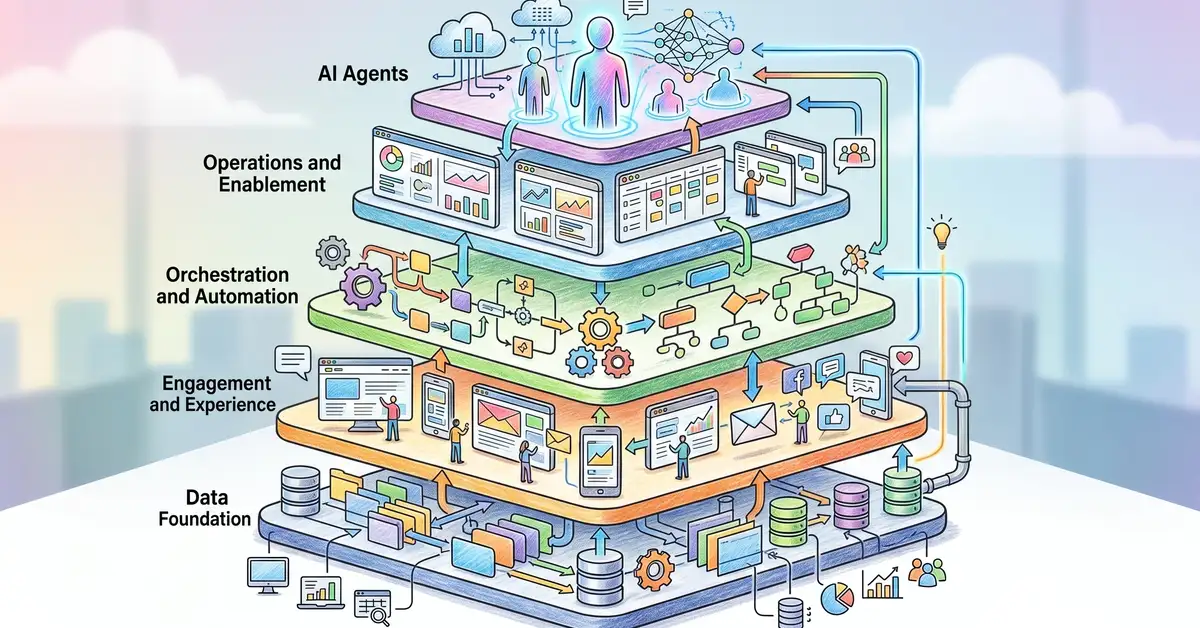
Visual diagram showing a B2B MarTech stack architecture with five interconnected layers from data foundation to AI orchestration

Why Do Most MarTech Stacks Fail to Deliver ROI?

Illustration of a frustrated marketing operations manager surrounded by disconnected software tools and tangled data flows

The MarTech landscape has grown from 150 solutions in 2011 to over 15,384 in 2025 — a staggering 10,156% increase, according to Chief MarTech's annual landscape report. Yet this explosive growth has not translated into proportional marketing performance. The reason is structural: most B2B teams have accumulated tools reactively — adding point solutions to address individual pain points without designing an integrated architecture.

The consequences are measurable and severe. Teams managing 15+ tools lose approximately 40% of operational time to tool management — logging in and out of systems, reconciling conflicting data, troubleshooting broken integrations — rather than strategic work. By contrast, teams with fewer than 8 well-integrated tools lose only 15%, redirecting 10+ hours per marketer per week toward growth activities, as reported by MarTech.org.

The financial impact compounds the operational drag. For SMBs under £50M revenue, licence costs ranging from £50,000–£150,000 annually balloon to £120,000–£350,000 in true total cost of ownership when implementation, integration maintenance, and staff time are factored in, according to William Flaiz's 2026 MarTech pricing analysis. For mid-market organisations (£50M–£500M revenue), that figure reaches £500,000–£1.5M against licence budgets of £200,000–£600,000.

What Are the 5 Core Layers of a MarTech Stack?

Every effective B2B MarTech stack, regardless of size or industry, operates across five interconnected layers. Understanding these layers is the first step toward auditing your current stack and identifying where consolidation will deliver the highest return.

Layer Function Typical Tools Common Gap
Data & Insights Centralises customer records, behavioural data, and analytics into unified profiles CRM (HubSpot, Salesforce), CDP, data warehouse, analytics Conflicting data definitions across systems
Engagement Delivers messages across customer touchpoints with consistent experience Marketing automation, CMS, social management, advertising platforms Channel-specific tools operating in isolation
Orchestration Connects data to engagement through workflows, APIs, and decision engines iPaaS (Zapier, Workato), API management, workflow automation Broken integrations failing silently for weeks
Operations Governs people, processes, training, and documentation that keep the stack healthy Project management, governance frameworks, training systems No formal stack ownership or audit cadence
AI & Agents Autonomous agents execute marketing workflows within governance guardrails AI co-pilots, generative content tools, predictive analytics, agent orchestration AI features activated without process redesign

Sources: Salesmotion 2026, MarTech360 Agent-First Stack 2026

The critical insight is that most stack failures happen at the orchestration layer. Individual tools perform well in isolation, but without reliable data flows between them, your CRM says one thing about a prospect while your marketing automation platform says another. Marketing Mary's workflow integration engine addresses this directly by unifying 12+ tools into a single source of truth — no Zapier hacks, no manual data reconciliation.

Suite vs Best-of-Breed vs Composable: Which Architecture Fits Your Team?

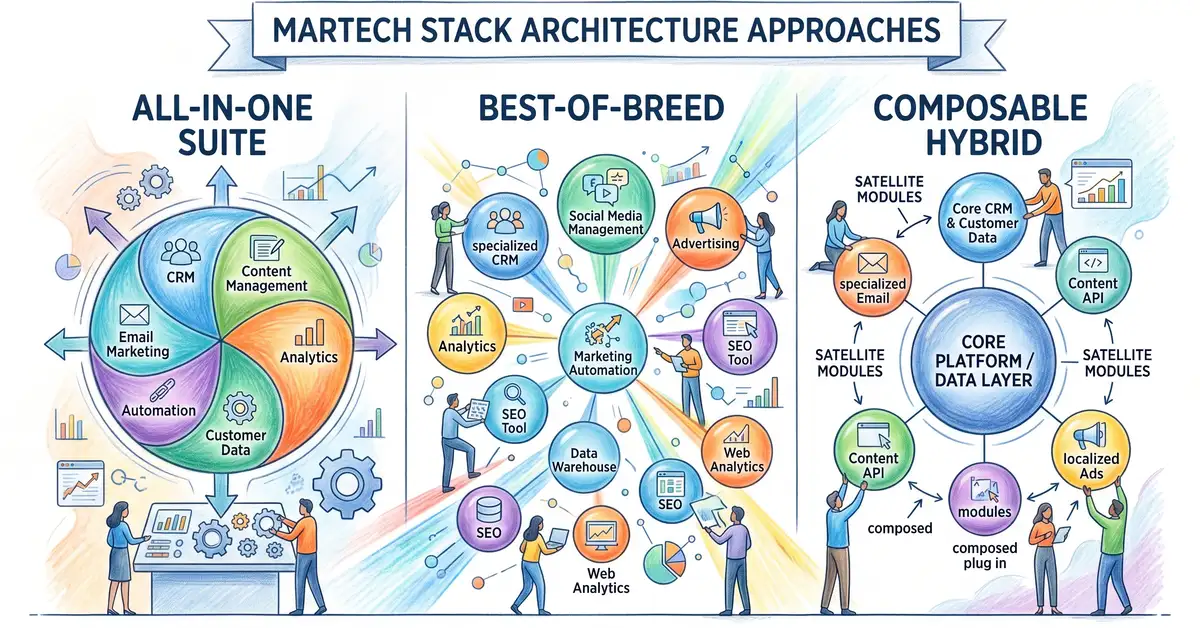
The strategic question every marketing operations leader faces is how to structure their stack. Three dominant architecture patterns have emerged, each with trade-offs that depend on your team size, technical capability, and budget constraints.

All-in-One Suite

Single vendor delivering 60–80% of functionality. HubSpot, Salesforce, or Adobe as your entire backbone.

Best for: Teams under 100 employees prioritising simplicity over specialisation. Lowest integration overhead.

Best-of-Breed

Category-leading specialist tool for each function, integrated via APIs and middleware.

Best for: Enterprises (500+) with dedicated MarTech ops teams and budget for integration maintenance.

Composable Hybrid

Strong central platform plus 3–5 carefully selected specialist tools connected through standardised APIs.

Best for: Mid-market B2B (50–500 employees) balancing capability depth with manageable complexity.

The composable hybrid has become the dominant pattern for mid-market B2B teams in 2025–2026. Heinz Marketing's consolidation analysis identifies three forces driving this shift: budget constraints, RevOps ownership of stack decisions (replacing departmental autonomy), and AI as a new evaluation criterion for every tool purchase. The most common setup for mid-market B2B companies is a combination of HubSpot, LinkedIn Ads, and Google Analytics — deployed by 28.5% of companies in the 50–500 employee segment, according to MarketBetter's 2025 analysis.

For a deeper comparison of architecture patterns and tool selection criteria, see our guide on how to build a B2B MarTech stack that actually works.

The Hidden Cost Trap

Common mistake: Comparing MarTech stacks by licence fees alone. A £50,000 CRM subscription becomes £150,000+ when you include implementation (£15,000–£40,000), integration maintenance, and the 50% of a marketing ops salary (£30,000–£42,500) spent managing the tool rather than running campaigns.

The reality: True total cost of ownership runs 2–3x the licence fee for every tool in your stack. One Fortune 500 company documented spending £330,000 on Salesforce licences while paying £1M annually to their systems integrator to keep it operational. Use our MarTech stack audit template to calculate your actual TCO.

Infographic comparing total cost of ownership across suite, best-of-breed, and composable hybrid MarTech stack architectures for mid-market B2B companies

Struggling with 12+ disconnected tools? See how Marketing Mary's workflow integration unifies your stack into a single source of truth.

View Workflow Integration

How to Audit Your MarTech Stack in 30 Minutes

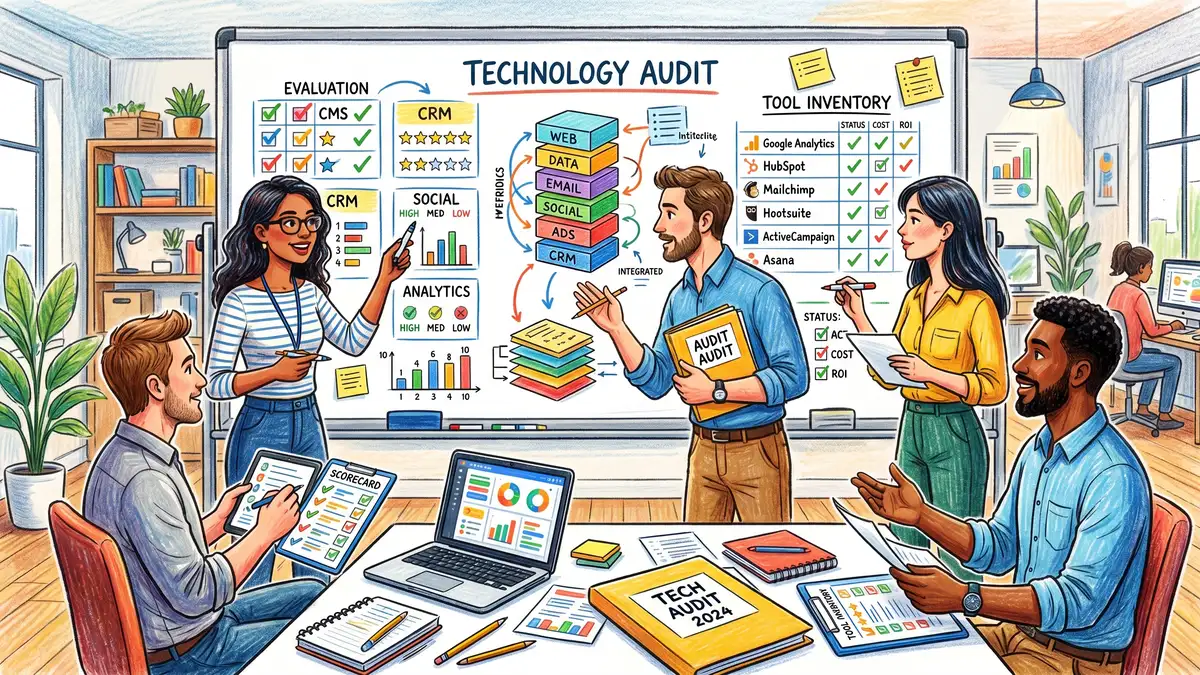
Illustration of a marketing team conducting a structured MarTech stack audit with scorecards and evaluation criteria

A structured stack audit is the fastest path from tool sprawl to strategic clarity. The framework below combines the 6Cs categorisation model from Smart Insights with HubSpot's 8-step operations audit checklist into a practical 30-minute exercise you can run with your team today.

Step 1: Build Your Tool Inventory (10 minutes)

List every marketing tool your team touches. For each tool, capture: name, primary function, annual cost, number of active users versus licensed seats, which other tools it integrates with, and contract renewal date. Most teams discover 30–40% more tools than they expected once they include one-off subscriptions, free tiers, and tools individuals adopted without team approval — what Mimecast's 2026 analysis calls "shadow AI."

Step 2: Score Each Tool (15 minutes)

Rate every tool on four dimensions using a 1–5 scale. Our downloadable MarTech Stack Audit Template (Excel) automates the scoring and generates a visual priority matrix.

Dimension What to Evaluate Score 1 (Poor) Score 5 (Strong)
Utilisation What percentage of purchased features does the team actively use? <20% of features used >70% of features used
Integration How reliably does data flow to and from this tool? Any manual workarounds? Manual CSV exports Real-time bi-directional sync
Overlap Does another tool in the stack deliver similar or identical functionality? 80%+ overlap with another tool Unique capability, no overlap
ROI Clarity Can you tie this tool's output to revenue, pipeline, or measurable efficiency? No measurable impact Direct revenue attribution

Step 3: Identify Quick Wins (5 minutes)

Any tool scoring below 8 out of 20 across all four dimensions is a consolidation candidate. In Marketing Mary's experience working with UK SME marketing teams, the first audit typically identifies 3–5 tools that can be eliminated immediately — saving £15,000–£40,000 annually before any deeper stack restructuring begins. For a detailed walkthrough of the audit methodology, download our MarTech stack audit template with automated scoring.

1

Inventory All Tools

List every marketing tool including free tiers, personal subscriptions, and shadow IT. Capture name, cost, users, integrations, and renewal date in your audit spreadsheet.

2

Score on 4 Dimensions

Rate each tool 1–5 on utilisation, integration quality, functional overlap, and ROI clarity. The template auto-generates a priority matrix highlighting consolidation candidates.

3

Map Data Flows

Document how customer data moves between systems. Identify where manual exports replace automated syncs, where field definitions conflict, and where integration failures go undetected.

4

Eliminate and Consolidate

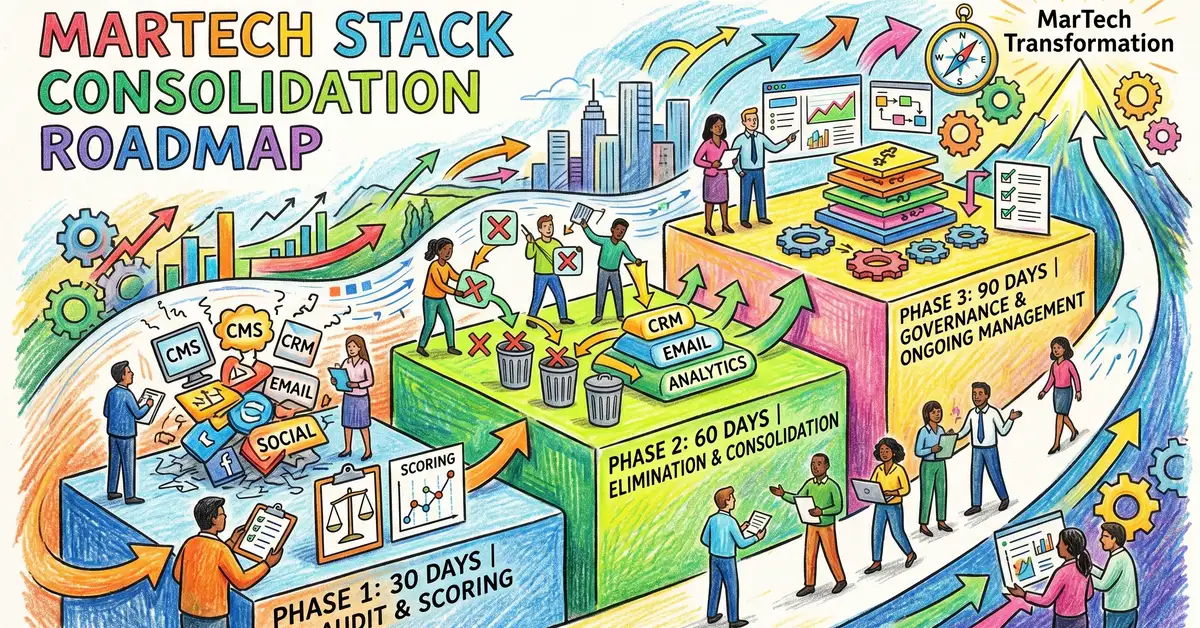
Cut tools scoring below 8/20. Merge overlapping tools. Build a 30-60-90 day roadmap for deeper consolidation. Organisations that consolidate typically reduce TCO by 20–31%.

5

Establish Ongoing Governance

Assign a stack owner. Schedule quarterly reviews. Create a formal intake process for new tool requests. Teams with structured governance avoid re-accumulating tool sprawl within 12 months.

How Much Does MarTech Stack Waste Actually Cost?

The financial reality of MarTech investment is that published licence fees represent only the surface. Marketing Mary's analysis of UK SME marketing operations reveals three compounding cost layers that most budgets ignore.

Cost Layer SMBs (<£50M revenue) Mid-Market (£50M–£500M) Enterprise (>£500M)
Licence Fees £50K–£150K £200K–£600K £800K–£3M+
True TCO £120K–£350K £500K–£1.5M £2M–£8M+
TCO Multiplier 2–2.5x licence 2.5–3x licence 2.5–3x+ licence
Wasted Capability £80K–£230K (67%) £330K–£1M (67%) £1.3M–£5.3M (67%)

Sources: William Flaiz MarTech Pricing 2026, Corcava Tool Sprawl Analysis 2026. Wasted capability calculated at 67% of TCO based on Gartner 33% utilisation rate.

The "wasted capability" row is the most important. When only 33% of purchased MarTech capabilities are utilised, two-thirds of your total investment is generating no measurable return. For an SMB spending £250,000 in true TCO, that represents approximately £167,000 annually in dormant capability — money that could fund two additional marketing hires or an entirely new campaign programme.

Companies that consolidate their stacks around a unified platform report 20–31% reduction in total cost of ownership, according to Corcava's 2026 tool sprawl analysis. Those with aligned sales and marketing functions using unified stack architecture achieve 38% higher win rates and 36% higher retention compared to fragmented competitors, per Landbase's RevOps analysis.

Three structural shifts are rewriting the rules of MarTech stack architecture for UK and EU B2B teams. Understanding these trends now positions your team to make stack decisions that remain viable through 2028 and beyond.

AI Agent-First Architecture

By 2028, MarTech360 predicts stacks will be rebuilt around autonomous agents that execute workflows rather than humans commanding individual tools. This demands open APIs, composable data, and unified governance — not more point solutions. Marketing Mary's AI co-pilot is built on this agent-first principle.

Consolidation Over Expansion

Budget constraints and RevOps ownership are driving teams toward multi-function "operating systems" rather than adding point solutions. Heinz Marketing reports that consolidation is now the dominant strategic response, with organisations actively reducing tool counts from 50+ to 15–25 core platforms.

The third trend — UK/EU regulatory compliance reshaping stack architecture — is particularly relevant for Marketing Mary's target market. Snowflake's 2026 MarTech evolution report confirms that GDPR compliance is now a baseline requirement integrated into every stack selection decision. Data clean rooms, privacy-compliant customer data platforms, and transparent data governance are becoming table-stakes technology — not optional privacy controls. For UK B2B teams, this means evaluating every tool in your stack for GDPR readiness and selecting platforms that support privacy-by-design architecture.

For a visual representation of how these architecture patterns translate into practical tool configurations, download our MarTech stack diagram template. And for a head-to-head comparison of how B2B and B2C stacks differ in architecture, budget, and tool selection, see our B2B vs B2C MarTech stack comparison guide.

The Bottom Line

Your MarTech stack's competitive advantage comes not from having more tools, but from having fewer, better-integrated tools operating within a clear governance framework. Organisations with consolidated stacks achieve 38% higher win rates, 20–31% lower TCO, and recover 8+ hours per marketer per week for strategic work. Start with the audit template below, score every tool, and cut the bottom 20%.

Strategic roadmap showing a 30-60-90 day MarTech stack consolidation plan from audit through implementation to governance

Frequently Asked Questions

What is the ideal number of tools in a B2B MarTech stack?

Most high-performing mid-market B2B teams operate 15–25 core tools, according to industry benchmarks. The median across all B2B organisations is 28 tools, but teams that have invested in consolidation consistently outperform larger stacks on both cost efficiency and campaign execution velocity. Focus on depth of integration rather than breadth of tools.

How often should you audit your MarTech stack?

Conduct a comprehensive audit twice annually, with lighter quarterly reviews between full audits. High-growth organisations or those undergoing go-to-market transformation may benefit from quarterly comprehensive reviews. The goal is catching emerging tool redundancy or integration failures before they calcify into permanent architecture patterns.

What is the difference between a CRM and a CDP in a MarTech stack?

A CRM (Customer Relationship Management) records what your organisation has communicated to customers — contacts, deals, interactions. A CDP (Customer Data Platform) tracks what customers have actually done across all touchpoints — website visits, email engagement, purchase history. CRMs are records of your activity; CDPs are records of customer behaviour. Many mid-market teams find that their CRM's built-in CDP-like features are sufficient without purchasing a standalone CDP.

How do you calculate MarTech stack ROI?

Calculate true ROI by measuring total cost of ownership (licence + implementation + integration + staff time) against measurable outcomes: pipeline influenced, leads generated, time saved, and revenue attributed. A tool generating £200,000 in attributed pipeline against £50,000 in true TCO delivers 4x ROI. Marketing Mary's audit template includes a built-in ROI calculator for each tool in your stack.

Should UK B2B teams prioritise GDPR compliance in MarTech stack selection?

Absolutely. GDPR compliance is now a baseline requirement — not a differentiator — for every tool in your stack. Evaluate each platform's data governance capabilities, data clean room support, audit trail functionality, and cross-border data transfer compliance. Vendors that cannot demonstrate GDPR readiness should be disqualified from your selection process, regardless of feature quality.

Ready to Unify Your MarTech Stack?

Marketing Mary connects your 12+ fragmented tools into a single AI-powered platform — eliminating 8+ hours of weekly tool management and £250K+ in annual waste. Start your free 14-day trial and see the difference unified stack architecture makes.

Start Your Free 14-Day Trial

Or test your messaging with AI buyer personas →

Clwyd Probert

Founder, Marketing Mary

Clwyd Probert is the founder of Marketing Mary, an AI-powered marketing co-pilot platform, and CEO of Whitehat, a London-based SEO and inbound marketing agency and HubSpot Platinum Partner since 2016. He has spent over a decade helping UK SMEs unify their marketing operations and eliminate tool sprawl.

Sources: Chief MarTech Landscape 2025, Gartner/CMSWire Utilisation Study, William Flaiz MarTech Pricing 2026, Heinz Marketing Consolidation 2026, Landbase RevOps Study 2026, Corcava Tool Sprawl 2026, Smart Insights 6Cs Framework, HubSpot Ops Audit Checklist 2026, MarTech360 Agent-First Stack 2026, Snowflake MarTech Evolution 2026

What Is a MarTech Stack? Complete Guide (+ Audit Template)

What Is a MarTech Stack? Complete Guide (+ Audit Template)

What Is a MarTech Stack? A MarTech stack is the integrated collection of marketing technology platforms, data flows, and automation tools that a...

Read More
Marketing Reporting Template: Build Reports That Drive Decisions

Marketing Reporting Template: Build Reports That Drive Decisions

Key Takeaway Marketing teams spend 20–60 hours per month on reporting — nearly half on formatting and commentary that adds no analytical value. The...

Read More
SaaS Marketing Strategy: The Complete Framework for 2026

SaaS Marketing Strategy: The Complete Framework for 2026

A SaaS marketing strategy is a structured plan for acquiring, converting, and expanding recurring-revenue customers through product-led acquisition,...

Read More
How to Build a MarTech Stack That Actually Works (Without 12 Disconnected Tools)

1 min read

How to Build a MarTech Stack That Actually Works (Without 12 Disconnected Tools)

Key Takeaway The average UK SME marketing team uses 12–30 disconnected tools, wastes £85,000–£180,000 per year on redundant subscriptions, and loses

Read More
Marketing Operations: The Complete Maturity Model, Roadmap & Stack Optimization Guide

1 min read

Marketing Operations: The Complete Maturity Model, Roadmap & Stack Optimization Guide

Marketing operations is the strategic function that connects your marketing technology MarTech stack architecture guide, data, processes, and people...

Read More
Lead Scoring Model Template: Build a Custom Scoring Rubric (Free Tool)

1 min read

Lead Scoring Model Template: Build a Custom Scoring Rubric (Free Tool)

Organisations that implement structured lead scoring see 77% higher lead generation ROI than those that do not score leads. Yet most B2B teams still...

Read More