
What is an evidence-graded buyer persona?
 Clwyd Probert: Sep 30, 2026, 8:25:00 PM
An evidence-graded buyer persona is a buyer persona in which every claim carries a label saying where it came from: first-party evidence (the...

Marketing operations is the strategic function that connects your marketing technology MarTech stack architecture guide, data, processes, and people into a unified system that drives measurable revenue. For B2B companies with 50-500 employees, marketing operations transforms disconnected tool stacks and manual workflows into integrated, automated pipelines. Lead nurturing, one of the processes it runs, shows the payoff: companies that excel at lead nurturing generate 50% more sales-ready leads at 33% lower cost, according to The Digital Bloom's B2B Lead Nurturing Research (2025).
Key Takeaway
91% of marketers now actively use AI in their work, up from 63% the year before, according to Jasper's 2026 survey. Adoption is no longer the hard part. The gap between AI adoption and operational excellence represents the single largest opportunity for B2B companies to gain competitive advantage through systematic process improvement rather than additional spend.
Marketing operations encompasses the technology, processes, data governance, and measurement frameworks that enable marketing teams to execute at scale. It is the operating system beneath every campaign, every lead handoff, and every attribution report. Yet most companies confuse marketing operations with marketing technology administration — treating it as a support function rather than the strategic discipline it has become.
The distinction matters. MarTech administration means configuring tools, managing user access, and troubleshooting integrations. Marketing operations means architecting the entire system: how data flows between platforms, how leads progress through lifecycle stages, how campaigns are measured against revenue, and how the team continuously improves execution speed and quality. Companies that treat marketing operations as admin get tool management. Companies that treat it as strategy get a revenue engine.

The evolution has been rapid. Five years ago, marketing operations meant CRM hygiene and email template management. Today, according to MarketingOps.com's 2025 State of the Profession report, modern MOps professionals function as technologists, strategists, and data stewards simultaneously — responsible for data quality, cross-functional sales-marketing alignment, predictive analytics, compliance governance, and AI workflow management.
The average B2B marketing technology stack now comprises 12-20 tools, with 92% of companies maintaining stacks of 20 tools or fewer, according to The Digital Bloom's B2B MarTech Stacks report (2025). Despite deliberate consolidation efforts, 62% of companies report increased tool adoption compared to two years prior. This paradox — more tools despite consolidation pressure — reflects the expanding scope of marketing operations from campaign execution into data orchestration, compliance automation, and AI governance.
12-20
Average Tools in Stack
92% have 20 or fewer
91%
Marketers Using AI
Up from 63% previous year
45%
Data Is Flawed
Incomplete, inaccurate, or outdated
2-3x
True Stack Cost
vs. visible license fees
Marketing operations maturity progresses through four distinct stages, each characterized by specific capabilities, process sophistication, and measurable outcomes. Understanding where your organization sits enables prioritized investment in the capabilities that drive the greatest improvement. The four levels below are adapted from Azola Creative's maturity framework.

Level 1: Ad Hoc. Marketing operations is manual, reactive, and disconnected. Processes exist in people's heads rather than documented workflows. Tools are loosely connected through CSV exports and manual data entry. Reporting relies on spreadsheets pulled weekly. Campaign cycle times are extended, error rates are high, and there is minimal visibility into marketing's revenue contribution. Most organizations with fewer than 10 marketing professionals operate at this level.
Level 2: Managed. Basic workflows are documented and repeatable. Platform selection becomes intentional. Data governance guidelines emerge — naming conventions, UTM standards, lifecycle stage definitions. Reporting moves from ad hoc to regular cadence, though analytics remain backward-looking. Organizations typically have designated marketing operations personnel, though often insufficient for the scope of activity. Campaign cycle times improve as processes become standardized.
Level 3: Optimized. Marketing operations transitions from managing individual tools to architecting integrated systems. Data governance is rigorous, with standards applied consistently across platforms. Multi-touch attribution replaces last-click models. Shared dashboards span sales and marketing, creating pipeline visibility. Predictive analytics enter routine workflows — lead scoring models incorporate machine learning, propensity models guide targeting. Teams run continuous improvement cycles (Plan-Do-Check-Act), testing process refinements systematically.
Level 4: Intelligent. AI and machine learning are fully operationalized across workflows. Predictive models anticipate customer behavior before it occurs. Automated quality assurance catches errors before campaigns launch. Marketing operations drives strategic decision-making across the go-to-market function, functioning as an internal product team with its own roadmap and performance accountability. This level represents the frontier — where marketing operations becomes a competitive moat rather than a cost center.
| Level | Process Maturity | Technology | Data Quality | Typical Outcome |
|---|---|---|---|---|
| Ad Hoc | Undocumented, reactive | Disconnected tools, CSV transfers | Inconsistent, no governance | High error rates, slow campaigns, no attribution |
| Managed | Documented, repeatable | Intentional selection, basic APIs | Guidelines emerging | Faster cycles, regular reporting |
| Optimized | Integrated, continuous improvement | Unified data layer, CDP | Rigorous, automated validation | Multi-touch attribution, predictive scoring |
| Intelligent | AI-augmented, predictive | Fully orchestrated, agentic AI | Real-time monitoring, self-healing | Strategic advisory, revenue driver |
Source: Adapted from Azola Creative Marketing Operations Maturity Model; Forrester B2B Marketing Benchmarks 2025.
The typical B2B marketing operations stack spans 10-15 functional categories, yet most companies over-invest in execution tools while under-investing in the integration and data layers that make those tools effective. Understanding the stack architecture helps marketing operations leaders prioritize investment where it creates the greatest operational leverage.
Foundation Layer
CRM (HubSpot, Salesforce), marketing automation, data warehouse. These are non-negotiable — the core infrastructure everything else connects to.
Intelligence Layer
Analytics, attribution, intent data, competitive intelligence. These tools tell you what's working, what's not, and where to invest next.
Execution Layer
Content management, social, paid media, email, landing pages. High-volume, high-visibility tools that consume most of the budget but depend on the layers beneath.
The critical insight from William Flaiz's MarTech cost analysis (2026) is that technology stack total cost of ownership typically runs 2-3x the vendor license fees. A mid-market organization ($50M–$500M revenue) paying $200-600K in visible license fees actually spends $500K-$1.5M annually when you factor in implementation costs, integration development, ongoing maintenance, and the headcount required to manage systems. This hidden cost multiplier is the primary reason stack consolidation is accelerating — not license fees themselves, but the operational burden of maintaining integrations between 15+ disconnected tools.
Heinz Marketing's 2026 consolidation analysis confirms the trend: companies are deliberately reducing tool count in favor of platforms that serve multiple functions. The trade-off is depth versus breadth — consolidated platforms rarely match best-of-breed specialists in any single capability, but the integration, data quality, and operational simplicity benefits outweigh the feature gaps for most mid-market organizations.
Fix the connections between the tools you already own before you buy new ones.

A structured 12-month roadmap transforms marketing operations from ad hoc to optimized by sequencing improvements in the right order. The most common mistake is jumping to advanced capabilities (predictive scoring, AI workflows) before establishing the data quality and process foundations they depend on. Based on frameworks from CRMT Digital and 4Thought Marketing's best practices guide, here is the recommended sequencing.
Months 1-3: Foundation
Audit your current tech stack (capabilities, costs, utilization rates). Document existing processes — even ad hoc ones. Establish data governance baseline: naming conventions, UTM standards, lifecycle stage definitions. Define lead scoring criteria. Quick win: automate your 3-5 most manual, repetitive tasks.
Months 4-6: Integration
Implement a unified data layer connecting CRM, marketing automation, and analytics. Establish bidirectional sync between marketing and sales platforms. Build multi-touch attribution baseline. Create shared marketing-sales dashboards. Train the team on new processes and tools.
Months 7-9: Optimization
Launch A/B testing framework for campaigns. Implement predictive lead scoring. Establish monthly ops review cadence (continuous improvement). Consolidate redundant tools. Build self-service reporting for stakeholders so the ops team stops being the reporting bottleneck.
Months 10-12: Intelligence
Deploy AI-augmented workflows for content, analytics, and lead routing. Implement automated data quality monitoring. Build predictive models for pipeline forecasting. Establish marketing ops as a strategic advisory function. Plan the next-year roadmap based on your maturity reassessment.
The sequencing matters because each phase builds on the previous one. Predictive lead scoring (Month 7-9) requires clean data (Month 1-3) flowing through integrated systems (Month 4-6). AI workflows (Month 10-12) require the continuous improvement culture and measurement frameworks established in the optimization phase. Skipping ahead creates technical debt that eventually forces expensive rework.
Ready to automate your marketing workflows? Our AI marketing automation guide shows where to start.
Read the Automation GuideEvery marketing operations transformation encounters predictable obstacles. Understanding these roadblocks before you hit them allows you to plan mitigation strategies from day one rather than reacting when momentum stalls.
Data quality is the most pervasive roadblock. CMOs estimate that 45% of the data their teams use for decision-making is incomplete, inaccurate, or outdated, according to Adverity's State of Marketing Data Quality report (2025). The same report cites a Gartner estimate that poor data quality costs each organization upwards of $12.9 million a year on average, through misleading insights, poor decisions and wasted resources. The fix is not a one-time cleansing project but an ongoing governance program: automated validation rules, regular deduplication cycles, and clear ownership of data quality metrics.

Tool fragmentation creates operational friction. Despite consolidation trends, the average B2B company still runs 12-20 marketing tools. Each integration point is a potential failure point — data syncs break, field mappings drift, and teams spend hours reconciling discrepancies between systems. The solution is ruthless prioritization: identify the 5-7 tools that deliver 80% of your value, invest in robust integrations between them, and evaluate whether remaining tools justify their maintenance burden.
Skill gaps limit what ops teams can deliver. Marketing operations requires a rare blend of technical proficiency (SQL, API management, automation platforms), analytical capability (attribution modeling, statistical analysis), and strategic thinking (process design, stakeholder management). Single hires rarely possess all three. Build teams with complementary skills — a technical specialist paired with a strategic generalist — rather than searching for unicorn candidates.
Sales-marketing alignment resists change. Marketing operations improvements often expose uncomfortable truths about lead quality, attribution credit, and pipeline contribution. Sales teams may resist new scoring models that change which leads get prioritized. Finance may question attribution methodologies that redistribute credit. The solution is involving stakeholders early — share the maturity assessment, co-design the roadmap, and establish shared KPIs that align incentives rather than creating zero-sum competitions.
The Hidden Cost Trap
Technology stack TCO runs 2-3x visible license fees. For example, a $300K annual tool budget actually costs $600-900K when you include implementation, integration development, maintenance, and the headcount to manage it all. Build this multiplier into every business case for new tools — and use it to justify consolidation where redundant tools create avoidable operational burden.
Three KPIs prove marketing operations drives measurable revenue impact, according to MarTech.org's research on ops metrics. These are not vanity metrics — they connect operational execution directly to business outcomes and give marketing operations leaders the evidence needed to secure continued investment.
| KPI Category | What It Measures | What good looks like | Why It Matters |
|---|---|---|---|
| Pipeline Contribution | % of sales pipeline influenced by marketing | A rising share of pipeline that marketing sources or influences | Proves marketing creates revenue, not just leads |
| CAC Efficiency | Cost discipline in customer acquisition | CAC falls while pipeline quality holds or improves | Demonstrates operational efficiency gains |
| Funnel Velocity | Speed from lead to customer | Less time from lead to customer | Reflects friction reduction in handoffs and processes |
| Data Quality Score | Completeness, accuracy, freshness | A completeness target you set and track | Foundation for every other metric's accuracy |
| Tool Utilization | % of features/licenses actively used | Most paid features and licenses in active use | Identifies waste and consolidation opportunities |
Source: KPI selection from MarTech.org (2025).
Beyond these revenue-focused KPIs, marketing operations teams should track process efficiency metrics: campaign cycle time (concept to go-live), throughput (campaigns per period), error/revision rate, and request turnaround time. These operational metrics identify bottlenecks and demonstrate continuous improvement — essential for justifying ongoing ops investment.
Use our marketing dashboard template to build one view of these KPIs across your tech stack, combining pipeline data from CRM, campaign metrics from marketing automation, and engagement data from analytics into a single reporting framework.
Marketing operations team structure scales non-linearly with organizational revenue, with significant capability jumps at specific thresholds. Benchmarking data from Digital Applied's 2026 Headcount Benchmarks provides clear guidance on when to invest in dedicated operations headcount and how to structure the function.
| Revenue Band | Marketing Team | MOps Allocation | Recommended Structure |
|---|---|---|---|
| $1-10M | 3 people | No dedicated MOps | Head of marketing absorbs ops. Use AI tools to automate what a dedicated hire would do. |
| $10-50M | 11 people | 1 dedicated hire | First MOps specialist: owns CRM, automation, reporting, data quality. Critical inflection point. |
| $50-250M | 26 people | 3-4 specialists (15%) | Head of MOps, automation specialist, MarTech manager, data analyst. Full functional team. |
| $250M+ | 50+ people | 8+ specialists (15%+) | VP MOps, team leads, AI ops role, RevOps alignment. Marketing ops as strategic business unit. |
Source: Digital Applied 2026 Marketing Team Structure Benchmarks; MarketingOps.com State of the Profession 2025.
For companies in the $10-50M range, the first dedicated marketing operations hire is often the most valuable one the marketing team makes. This person takes on the manual processes that eat into every marketer's week, establishes the data foundation everything else depends on, and creates the operational capacity for the marketing team to scale output without proportional headcount growth.
If you are evaluating whether to build your marketing team in-house, through an agency, or as a hybrid, marketing operations capability should be a primary consideration. In-house teams need ops infrastructure to function effectively. Agencies provide execution but rarely invest in your operational foundation. The hybrid model — in-house ops with agency execution — often delivers the strongest results for mid-market companies.
AI has shifted from experimental to foundational in marketing operations. According to Jasper's State of AI in Marketing 2026 report, 91% of marketers now actively use AI — up from 63% the previous year. Jasper describes the shift as a move from adopting AI to operationalizing it.
The practical impact on marketing operations is measurable. In Jasper's survey, 50% of marketers say they are bringing work to market faster with AI, and 45% have lowered operating costs. The gains show up in content production, analysis, campaign setup, automation builds and lead scoring, and they compound when AI is built into documented workflows rather than used for one-off tasks.
Marketing Mary helps with the content side of this: it builds evidence-graded personas from your website and writes articles to your approved brand identity, with a person approving each one. Our guide to AI-driven content strategy covers the method.
The emerging frontier is agentic AI — autonomous systems that execute multi-step marketing operations tasks with human oversight rather than human direction. Early applications include automated lead routing based on real-time scoring, campaign performance monitoring with autonomous budget reallocation, and content workflows that research, draft, and schedule without manual intervention. Marketing operations teams that invest in AI governance frameworks now will be positioned to deploy agentic capabilities as they mature.
Key Takeaway
AI isn't replacing marketing operations; it's adding to what the team can do. The 91% adoption rate means AI is table stakes, not a differentiator. The competitive advantage now lies in how well your operations function integrates AI into systematic workflows rather than using it for ad hoc tasks. Build AI into your ops roadmap from Month 1, not as an afterthought in Month 12.
Transforming marketing operations begins with an honest assessment of where you stand today. Use the maturity model above to place your organization at one of the four levels, then follow these three steps to begin your roadmap.
Step 1: Audit Your Current State
List every tool in your stack with its cost, integration status, and utilization rate. Document your top 10 workflows. Measure your data quality across completeness, accuracy, and freshness. This audit creates the baseline every improvement will be measured against.
Step 2: Prioritize by Impact
Rank improvements by the formula: time saved × frequency × people affected. A workflow fix that saves 30 minutes daily for 5 people delivers 125 hours per month — worth more than a flashy AI project that saves 2 hours weekly for one analyst.
Download our free Marketing Operations Roadmap Template (Excel) and MarTech Stack Audit Checklist (PDF) below to structure your assessment and build a prioritized improvement plan.
Marketing Mary provides free tools to help you assess, plan, and execute your marketing operations transformation. Both resources follow the maturity framework and roadmap sequencing covered in this guide.
Marketing Operations Roadmap Template (Excel)
12-month roadmap template with maturity assessment, prioritized task sequencing by quarter, KPI tracking dashboard, and stack audit worksheet. It uses the guide's maturity levels, KPIs and 2-3x TCO estimate: enter your scores to see your overall maturity level and where to start on the roadmap.
MarTech Stack Audit Checklist (PDF)
40-question checklist covering tool inventory and costs, integration health, data quality and governance, process and workflow maturity, and measurement. Count the items you can check in each section to see where you sit on the maturity levels and find the highest-impact improvements.
Marketing operations is the strategic function that manages marketing technology, data governance, process automation, and performance measurement. It matters because the processes it runs pay off: The Digital Bloom's 2025 research found that companies that excel at lead nurturing generate 50% more sales-ready leads at 33% lower cost. For B2B companies running 12-20 marketing tools, ops is the discipline that turns tool sprawl into an integrated revenue engine.
The usual point for a first dedicated marketing operations hire is when your company crosses $10M in revenue. Digital Applied's 2026 benchmarks show a marketing operations role typically appearing in the $10-50M band, where the median marketing team is 11 people. At this stage, the operational burden of managing tools, data, and processes exceeds what generalist marketers can absorb. Delaying this hire creates compounding technical debt that becomes increasingly expensive to remediate.
The average B2B marketing stack comprises 12-20 tools, with 92% of companies maintaining 20 or fewer. The optimal number depends on your organization's size and complexity, but the trend is toward consolidation — fewer, better-integrated platforms rather than best-of-breed point solutions. The key metric is not tool count but integration health: how well data flows between systems without manual intervention.
Three KPIs prove marketing ops drives revenue: pipeline contribution (% of sales pipeline influenced by marketing), customer acquisition cost efficiency (demonstrating cost discipline), and funnel conversion velocity (speed from lead to customer). Supplement these with operational metrics: data quality score, campaign cycle time, tool utilization rate, and stakeholder satisfaction.
AI augments marketing operations by automating repetitive workflows such as content production, improving lead scoring with machine learning models, and speeding up analysis and insight generation. With 91% of marketers now using AI, the advantage lies not in adoption but in systematic integration into operational workflows — building AI into your ops infrastructure rather than using it as an ad hoc productivity tool.
See what Mary finds on your website.
Join the early-adopter list and be one of the first to try Mary on your own website.
Plans from Free to Enterprise · pricing to be confirmed
Clwyd Probert
Clwyd Probert is the founder of Marketing Mary, an evidence-first persona intelligence platform for B2B marketing, and CEO of Whitehat, a London-based SEO and inbound marketing agency and HubSpot Diamond Solutions Partner.
Sources: Marrina Decisions MOps Roadmap (2026); The Digital Bloom B2B MarTech Stacks (2025); Adverity State of Marketing Data Quality (2025); Jasper State of AI in Marketing (2026); MarTech.org Marketing Ops KPIs; William Flaiz MarTech Cost Analysis (2026); Digital Applied Team Structure Benchmarks (2026); MarketingOps.com State of the Profession (2025); Azola Creative Maturity Model; Forrester B2B Marketing Benchmarks (2025); Heinz Marketing Stack Consolidation (2026).
 Clwyd Probert: Sep 30, 2026, 8:25:00 PM
An evidence-graded buyer persona is a buyer persona in which every claim carries a label saying where it came from: first-party evidence (the...
 Clwyd Probert: Sep 9, 2026, 11:58:11 PM
Our own Search Console tells this story: impressions up 53% and clicks down 6% in the 28 days to September 6, 2026, compared with the 28 days before,...
 Clwyd Probert: Aug 25, 2026, 10:16:09 AM
You can find HubSpot's credit rates. You can find your monthly allowance. What you cannot easily find is the sentence that connects them — so most...
 Clwyd Probert : May 3, 2026, 11:00:00 AM
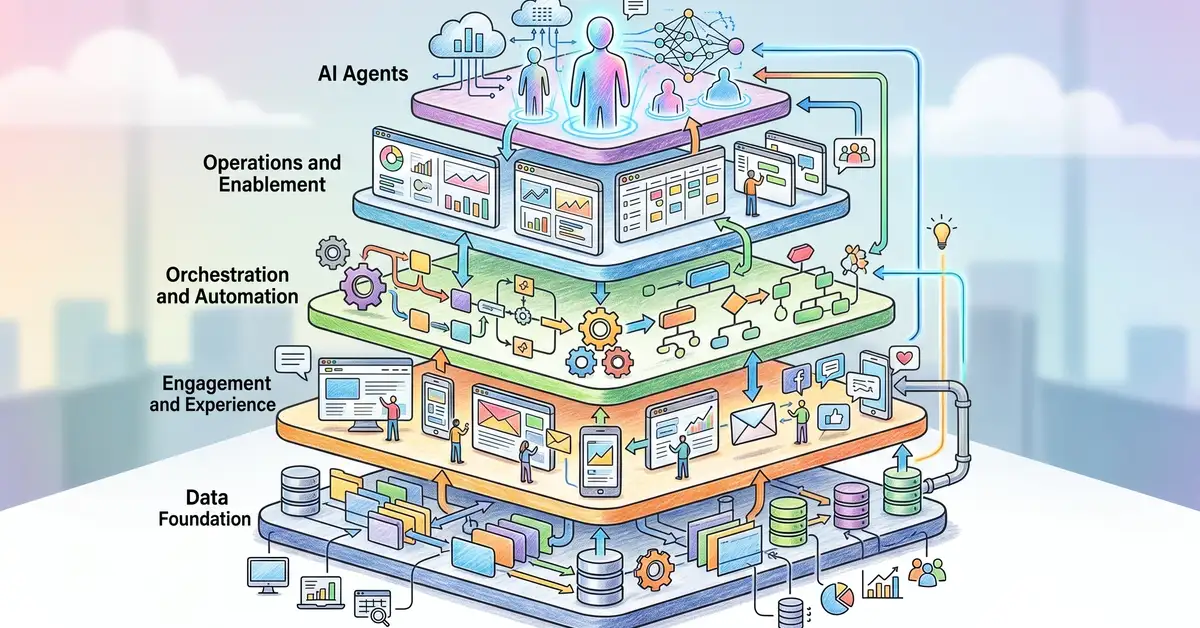
What a MarTech stack is, the 5 core layers, and how suite, best-of-breed and composable setups compare, with cost benchmarks for B2B marketing teams.
 Clwyd Probert : May 4, 2026, 11:00:00 AM
Learn the four-phase framework for building a B2B martech stack without tool sprawl, using a hub-and-spoke architecture.
 Clwyd Probert : Mar 24, 2026, 9:30:00 PM
What separates a true AI marketing agent from a chatbot: the five capabilities that define real agents, and how a small marketing team can start with...