What is an evidence-graded buyer persona?
 Clwyd Probert: Sep 30, 2026, 8:25:00 PM
An evidence-graded buyer persona is a buyer persona in which every claim carries a label saying where it came from: first-party evidence (the...
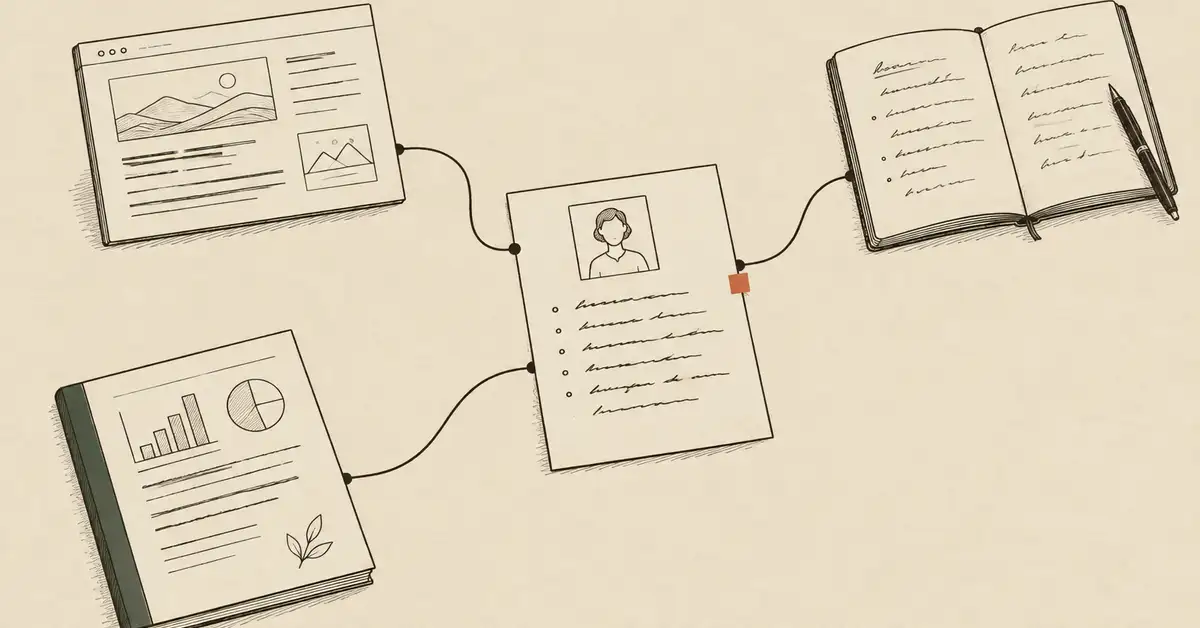
An evidence-graded buyer persona is a buyer persona in which every claim carries a label saying where it came from: first-party evidence (the company's own website, customers or records), researched evidence from a named outside source, or synthesis reasoned from the two and marked as such. What nobody could verify is shown as a gap, not filled in.
The grade does not tell you whether a persona is right. It tells you how much of it you could defend when a CEO, a board or a skeptical sales team asks "where did that come from?" Below: what the labels mean, why they matter more now that AI tools write persona copy in seconds, how to grade a persona yourself, and how Marketing Mary does it.
Key takeaway
An evidence-graded persona separates what you know (first-party), what someone else found (researched, with a source you can link), and what you reasoned (synthesis). The mix of those three is the persona's evidence mix. A persona that is mostly synthesis can still be useful, as long as everyone can see that it is mostly synthesis.
In an evidence-graded buyer persona, the unit of grading is the individual claim, not the whole document. "Heads of Operations at 200 to 800 person firms" is one claim; "starts looking for software after a failed audit" is another. Each gets its own source and label, so weak claims cannot borrow credibility from strong ones.
Three labels cover almost everything a marketing team writes into a persona:
A fourth state matters as much as the three labels: not known. If nobody could find evidence for a claim, an evidence-graded persona says so instead of inventing a plausible answer. That visible gap tells you what to research next.
The evidence mix is the share of a persona's claims that rest on each kind of evidence: how much is first-party, how much is researched and how much is synthesis. It turns the labels into a summary a reader can take in at a glance. A persona that is 60% first-party tells a different story from one that is 60% synthesis, even if the two read equally confidently.
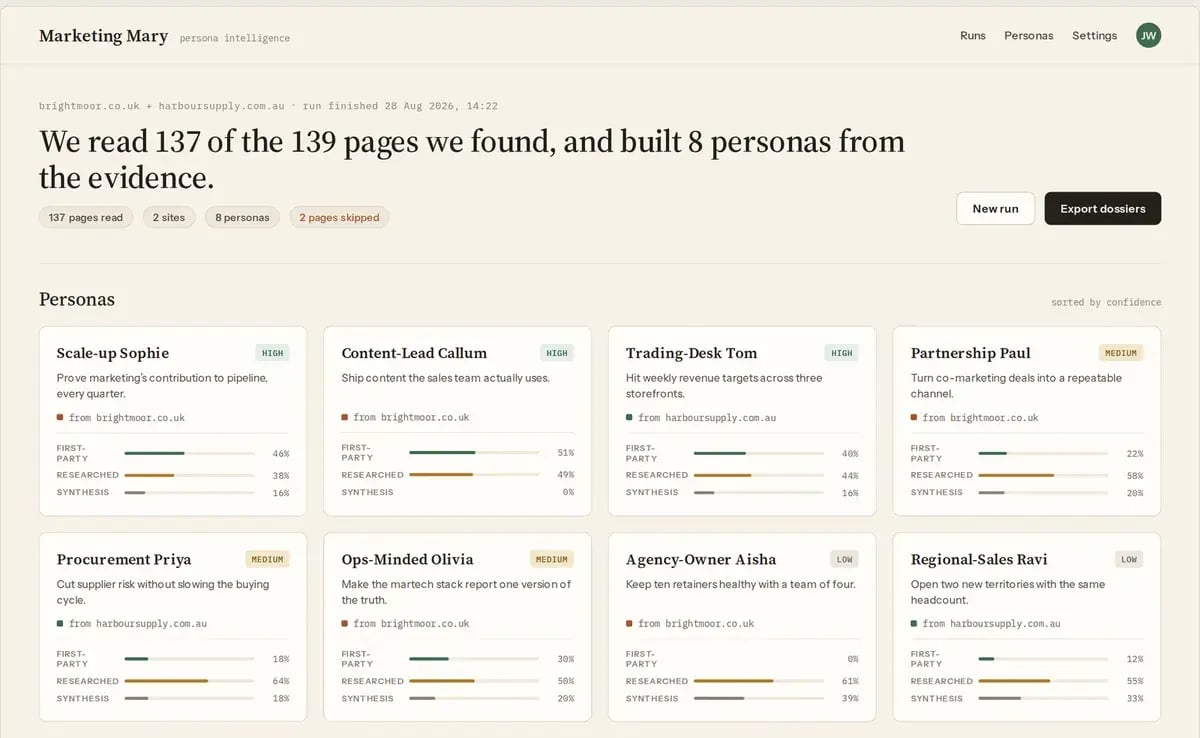
Marketing Mary's results screen: each persona card shows its evidence mix as three labeled bars. Companies, personas and figures are fictional sample data.
In the example above, a persona that is 0% first-party sits next to one that is 51% first-party. Both may be worth keeping, but only one is ready to justify a budget decision. The low-evidence persona is not a failure; it is a research brief.
Evidence grading is not new; it is newer to marketing personas. Two fields have done it for years, and both are worth borrowing from.
In medicine, the GRADE working group, which began in 2000, rates the certainty of a body of evidence as high, moderate, low or very low, and its approach is now considered the standard in clinical guideline development. The point is transparency: a guideline shows how it reached each judgment.
In US intelligence analysis, the Office of the Director of National Intelligence's Intelligence Community Directive 203 requires analytic products to describe "the quality and credibility of underlying sources" and to "clearly distinguish statements that convey underlying intelligence information" from "statements that convey assumptions or judgments." Swap "intelligence" for "customer evidence" and you have an evidence-graded persona.
Evidence grading matters because most personas are built under conditions that hide where their claims came from. Nielsen Norman Group's guide to persona types describes "proto personas" as ones created with no new research, often "based solely on the team's assumptions," and warns they "can be an echo chamber for the team's incorrect assumptions." Proto personas can be a sensible start. The problem is presenting one to leadership as research, with nothing on the page saying otherwise.
AI writing tools make that sharper: a language model will write a detailed, confident persona from a one-line prompt, and it looks equally authoritative whether or not any of it is true. Three studies show why unsourced AI output needs a label:
74%
Demographics-only AI agents
of people's own test-retest consistency, when predicting how 1,052 Americans answered survey questions
researched · Park et al., 2026
83%
Interview-grounded AI agents
on the same test, when each agent was built from a two-hour interview with the real person
researched · Park et al., 2026
18%
Fabricated citations (GPT-4)
of 636 references in AI-written literature reviews tested in 2023; 55% for GPT-3.5
researched · Walters & Wilder, 2023
The first two figures come from a study by Park and colleagues, LLM agents grounded in self-reports (revised June 2026), which built AI "agents" of 1,052 real people. Agents given the person's own interview predicted that person's survey answers at 83% of the consistency people show with themselves two weeks later; agents given only demographics reached 74%. Evidence about the actual person beat a demographic profile.
Columbia University researchers found the reverse effect when the model supplies the detail. In LLM generated persona is a promise with a catch (2025), they generated about one million personas with six open-source models and tested them on more than 500 questions. Bias grew as more of the persona was written by the model, and one persona type predicted a Democratic sweep of every US state in a simulated 2024 presidential election. The third figure, from a 2023 Scientific Reports study, is older and covers older models, but the lesson holds: fluent text and sourced text are different things, and only a label tells the reader which is which.
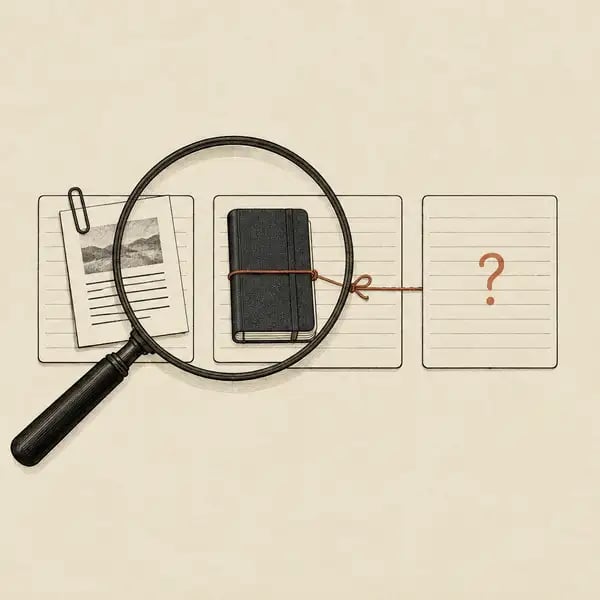
You can evidence-grade an existing persona in an afternoon with a spreadsheet. The method below works for a persona built from a buyer persona template, one written in a workshop, or one an AI tool produced.
1. Break the persona into single claims. One row per statement. "Busy, data-driven Head of Ops who hates long demos" is three claims, not one.
2. Write the source next to each claim. Be specific: "win/loss notes, last 12 deals" or a link to the named report. If the honest answer is "the workshop" or "an AI tool", write that down.
3. Label it. First-party, researched or synthesis. If there is no source at all, mark it not known rather than guessing.
4. Count the mix. Tally the labels. That is the persona's evidence mix, and it belongs at the top of the document.
5. Turn the gaps into a research plan. Every synthesis or not-known claim that drives a real decision (budget, messaging, targeting) is the next interview question or the next report to find. For qualitative personas, NN/g suggests interviewing 5 to 30 users in rolling groups of five until each new interview adds only a few new insights.
Here is what the finished grid looks like for a fictional persona, "Ops-Lead Olivia", at a fictional workflow-software company:
| Attribute | Claim | Source | Grade |
|---|---|---|---|
| Role | Head of Operations at a 200–800 person company | CRM export, last 40 closed-won deals | first-party |
| Trigger | Starts looking after a failed compliance audit | Mentioned in 6 of 9 win interviews | first-party |
| Pressure | Leadership wants process data every quarter | Named analyst survey, linked in the persona | researched |
| Channel | Trusts peer communities more than webinars | Reasoned from the trigger and role; not tested | synthesis |
| Budget | Holds her own software budget | No evidence found yet | not known |
Fictional example. Evidence mix: 2 first-party, 1 researched, 1 synthesis, 1 not known.
The grid shows who Olivia is and what triggers her search are well supported; where to reach her and whether she can buy are not. A campaign plan needs to know that before money goes into a channel.
See what Mary finds on your website
Give Marketing Mary a web address. She reads the site, builds evidence-graded buyer personas, and shows you where every conclusion came from.
Join the early-adopter listTrust first-party evidence most, researched evidence as far as its source deserves, and synthetic persona data only as far as it is grounded in the other two. That is not a rule against synthetic personas. Forrester, in an August 2026 post on synthetic personas, sees them as useful for testing messages, but is blunt about the limit: "Organizations cannot simply ask generative AI to create buyer personas from a prompt and expect meaningful results," and effective synthetic personas "must be grounded in proprietary data, primary research, validated customer insights, and organizational context."
The studies above point the same way: grounding in real interviews helped, and bias grew as the model filled in more of the persona itself. In evidence-graded terms, a synthetic persona inherits its grade from what it was built on. Built from your customer interviews, it can carry first-party claims. Built from a prompt, everything in it is synthesis until checked.
Five ways evidence grading goes wrong
Grading the document, not the claim. A persona stamped "validated" as a whole hides which parts were validated.
Writing quotes. An invented "customer quote" is synthesis dressed as first-party evidence. If a quote is not taken word for word from a real source, it should not be in quotation marks.
Citing the citation. A statistic found in a blog roundup is only as good as the original report behind it. If you cannot open the original, grade the claim by what you can open.
Filling gaps to look finished. A blank marked not known is more useful than a confident guess, because it tells the next person what to find.
Never re-grading. Grades describe the evidence you had on a date. Put the date on the persona and re-grade when a new source arrives.
Most of these come from wanting the persona to look complete. It is more useful for a persona to look unfinished where it is. If you are starting from scratch, our guide on how to create a buyer persona covers the research steps; grade as you go rather than at the end.
Marketing Mary builds evidence-graded buyer personas from a company's web address. Mary reads the website, works out who the company is and who it sells to, and labels every statement with where it came from: stated on your website, worked out from your website, or inferred for Mary's own reading that is not stated anywhere. When a person corrects a fact, the change is marked "added by you", the original reading is kept, and the correction shapes the personas built next.
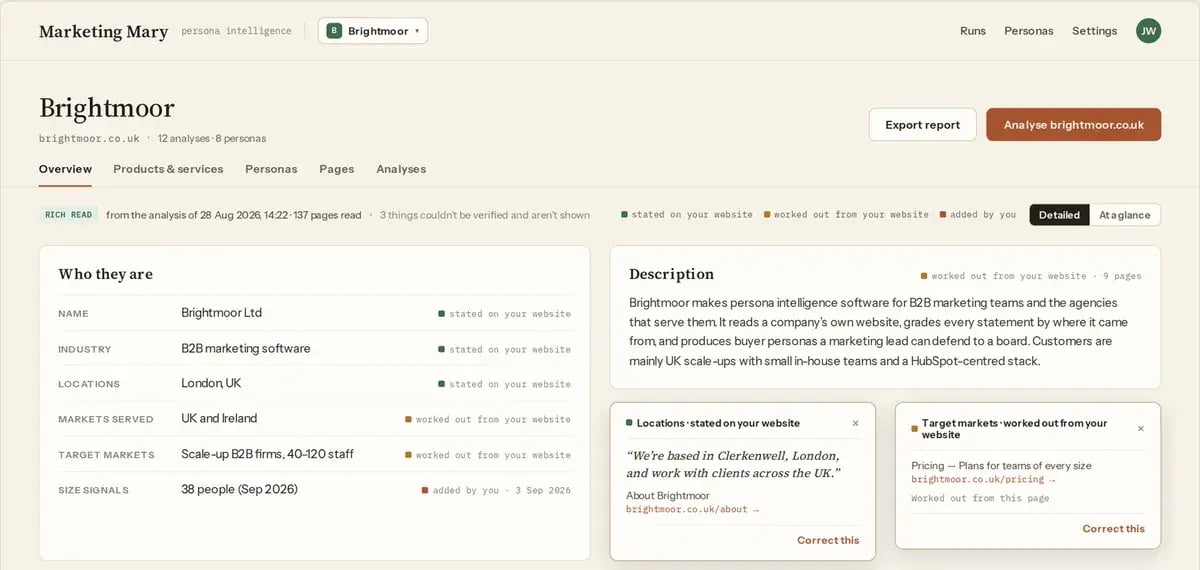
Every line on Marketing Mary's company overview carries its source label; opening a label shows the sentence and the page it came from. Fictional sample data.
Three rules keep the grades honest. Quotes are extracted, never written: the language model names the pages that support a claim, and Marketing Mary pulls the quote from its stored copy of that page and checks it, so a fabricated quotation is prevented by design. What can't be verified isn't shown as fact: the screen says so plainly, for example "3 claims couldn't be verified and aren't shown". Each persona carries an evidence mix of first-party, researched and synthesis evidence, and each section of its dossier is graded with its sources cited.
A website tells you what a company says about its buyers, not what the buyers say. So Marketing Mary shows where each persona rests on the site, outside research or synthesis, and says what it could not find. Your own customer interviews remain the strongest evidence you can add to any persona.
Not quite. A data-driven persona uses data somewhere in its making; an evidence-graded persona labels each claim with its source and grade, so a reader can see which parts rest on data and which rest on reasoning. Marketing Mary grades every persona claim this way.
Nielsen Norman Group suggests 5 to 30 interviews for qualitative personas, run in rolling groups of five until each new interview adds only a few new insights. In an evidence-graded persona, each interview-backed claim is labeled first-party and can note how many interviews support it.
They are only as reliable as what they are built on. A 2026 study by Park and colleagues found AI agents built from real interviews beat demographics-only agents (83% vs 74% of test-retest consistency), and Columbia researchers found bias grew as models wrote more of the persona. Grade prompt-built personas as synthesis until checked.
First-party persona data comes from the company itself: its website, CRM, win/loss notes or customer interviews. Synthetic persona data is generated by a model. It can be grounded in first-party evidence, but on its own it is synthesis, not a finding.
Yes. Break each persona into single claims, write the source beside each, label it first-party, researched or synthesis, and mark unsupported claims as not known. The count of labels is the persona's evidence mix, and the gaps become your research plan.
Join the Marketing Mary early-adopter list
Be among the first to use Marketing Mary: personas your board can defend, with every conclusion showing where it came from. Pricing to be confirmed.
Sources, checked against the original documents on Sep 30, 2026
researched Park et al., LLM agents grounded in self-reports enable general-purpose simulation of individuals. arXiv, revised Jun 28, 2026.
researched Li, Chen, Namkoong and Peng, LLM generated persona is a promise with a catch. Columbia University, arXiv, Mar 2025.
researched Walters and Wilder, Fabrication and errors in the bibliographic citations generated by ChatGPT. Scientific Reports 13, 14045, Sep 2023.
researched Laubheimer, 3 persona types: lightweight, qualitative, and statistical. Nielsen Norman Group, Jun 2020.
researched Intelligence Community Directive 203: Analytic Standards. ODNI, 2015, as amended.
researched GRADE working group. Accessed Sep 30, 2026.
researched Winters and Conard, The real promise of synthetic personas is better activation. Forrester, Aug 19, 2026.
first-party How Marketing Mary labels claims, extracts quotes and shows its evidence mix: Marketing Mary's own product documentation. Screens show fictional sample data.
Clwyd Probert: Sep 30, 2026, 8:25:00 PM
An evidence-graded buyer persona is a buyer persona in which every claim carries a label saying where it came from: first-party evidence (the...
 Clwyd Probert: Sep 9, 2026, 11:58:11 PM
Our own Search Console tells this story: impressions up 49% in four weeks, clicks down 12% over the same period, average position improving from 11.3...
 Clwyd Probert: Aug 25, 2026, 10:16:09 AM
You can find HubSpot's credit rates. You can find your monthly allowance. What you cannot easily find is the sentence that connects them — so most...
 Clwyd Probert : Mar 22, 2026, 3:48:21 PM
Create B2B buyer personas in 30 minutes instead of 6 weeks. Free downloadable template, real examples, and the AI shortcut that actually works.
 Clwyd Probert : May 5, 2026, 10:00:00 AM
40–60% of buyer personas are abandoned within 6 months. We tested 7 AI persona tools in 2026 — HubSpot, Delve.ai, UXPressia & more.
 Clwyd Probert : Aug 4, 2026, 10:31:43 AM
Only Breeze is truly native. A small group of Marketplace apps have real two-way sync, and most tools are merely connected. The three tiers, with...
