
What is an evidence-graded buyer persona?
 Clwyd Probert: Sep 30, 2026, 8:25:00 PM
An evidence-graded buyer persona is a buyer persona in which every claim carries a label saying where it came from: first-party evidence (the...

A marketing team structure defines how roles, responsibilities, and reporting lines are organized to turn strategy into revenue. The right structure depends on your company size, revenue stage, business model, and go-to-market complexity — and getting it wrong creates bottlenecks that cost real pipeline. UK B2B companies generating £10–50 million in revenue operate with a median of 11 marketers, whilst those crossing £50 million typically need 26, according to Gartner's 2026 Marketing Survey.
This guide gives you the complete framework: org chart templates by company size, every core marketing role defined with UK salary benchmarks, a hiring roadmap showing which roles to add when, and the red flags that signal your current structure is holding you back. Whether you are building your first marketing team or restructuring for the next growth stage, this framework gives you a blueprint built on the benchmarks below.
3 → 11 → 26
Median Team Size
By revenue band (£1-10M, £10-50M, £50-250M)
56%
AI Skills Wage Premium
Jobs that require AI skills (PwC 2025)
Sources: Gartner 2026 Marketing Survey, PwC 2025 Global AI Jobs Barometer
See what Mary finds on your website.
Join the early-adopter list and be one of the first to try Mary on your own website.
Plans from Free to Enterprise · pricing to be confirmed
Every marketing organization falls into one of three structural models — centralized, pod-based (decentralized), or hybrid. Your choice directly impacts how fast campaigns ship, how consistent your brand stays, and how well marketing aligns with sales and product. Gartner's survey of more than 380 marketing and communications leaders found that B2B marketing organizations favor a balanced or hybrid structure, while B2C organizations are mostly centralized.
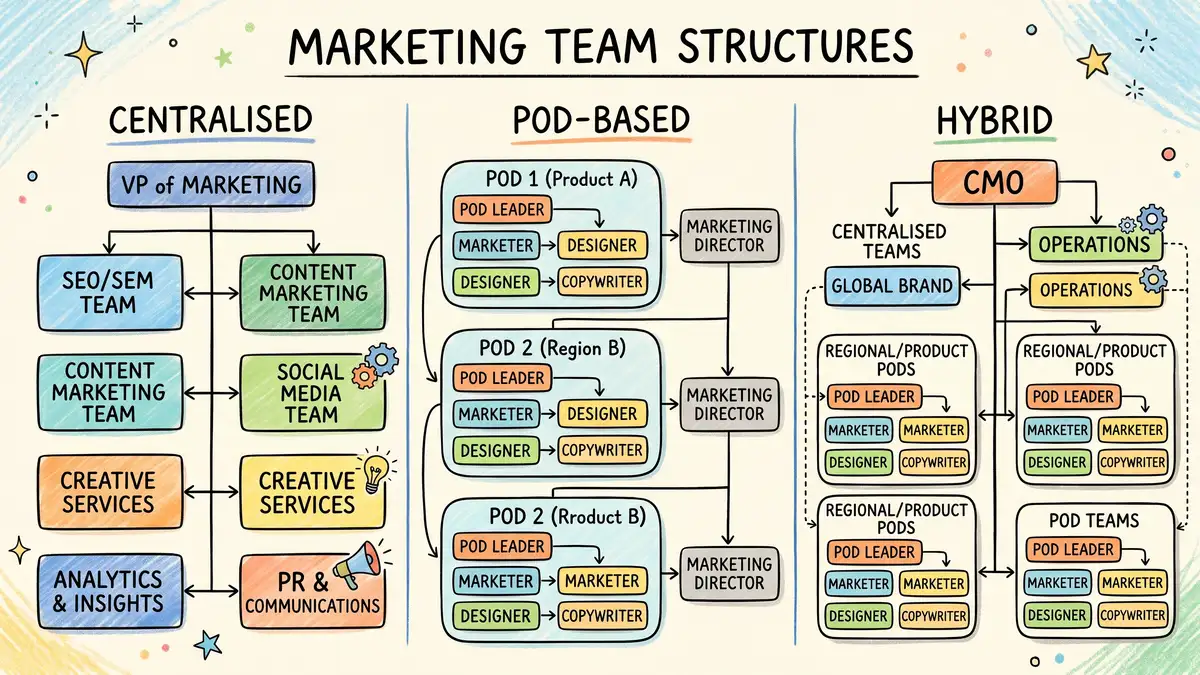
Centralized
All marketers report through one leader. Maximizes brand consistency and resource efficiency. Best for teams under 8 people or single-product companies. Risk: becomes a bottleneck as you scale beyond £30M revenue.
Pod-Based
Cross-functional pods align to verticals, products, or regions. Each pod has demand gen, content, and ops. Best for account-based marketing and multi-vertical strategies. Risk: brand fragmentation and duplicated roles.
Hybrid
Core functions (brand, ops, analytics) sit centrally. Execution pods distribute to business units. Balances consistency with speed. Best for mid-market and enterprise with 9+ marketers and multiple GTM motions.
The structure you choose should evolve with your revenue. Startups naturally centralize because the team is small enough to coordinate through daily stand-ups. Growth-stage companies (£10–30M) begin specializing within a centralized frame. Mid-market organizations (£30–100M) typically hit an inflection point where hybrid structures become necessary to maintain both speed and consistency. The wrong structure at the wrong stage creates measurable drag on revenue — and Marketing Mary's marketing operations framework can help you assess whether your current structure is fit for purpose.
Mature B2B marketing teams tend to put the largest share of headcount into demand generation and content, with smaller shares for marketing operations, brand/creative, product marketing and leadership. Understanding each function helps you identify which capabilities to build first.
| Function | Share of Team | Key Roles | Primary Responsibilities |
|---|---|---|---|
| Demand Gen | Largest | Demand Gen Manager, Paid Media Specialist, Events Manager, Email Specialist | Pipeline creation across paid, email, events, and partnership channels |
| Content | Large | Content Strategist, Writers, Content Ops, Designer | Strategy, production, distribution, and brand voice governance |
| Marketing Ops | Medium | MarTech Admin, Data Analyst, Reporting Specialist | Tech stack management, data quality, attribution, process automation |
| Brand / Creative | Medium | Brand Strategist, Graphic Designers, Brand Ops | Visual identity, design systems, brand guidelines, creative production |
| Product Marketing | Medium | Product Marketer, Competitive Intel, Sales Enablement | Positioning, messaging, product launches, competitive intelligence |
| Leadership | Smallest | CMO/VP Marketing, Chief of Staff, Program Management | Strategy, budget allocation, cross-functional alignment, hiring |
SaaS companies tend to weight product marketing more heavily because positioning and launch execution directly drive expansion revenue. Enterprise sales-led companies push demand generation higher to fuel account-based pipelines. The weightings above are starting points — adjust based on where your revenue actually comes from.
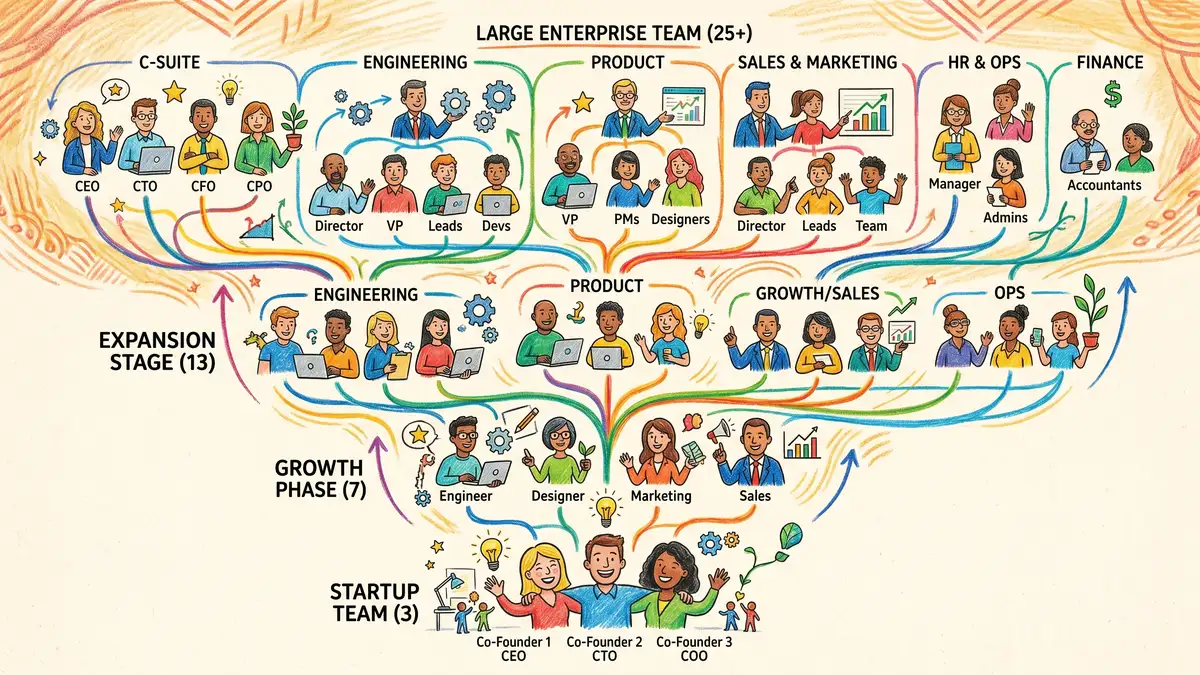
Marketing team structures follow predictable patterns at each revenue band. The jump from 3 to 11 marketers is not linear — it represents a genuine shift in complexity where functional specialization becomes necessary and the Head of Marketing transitions from doing marketing to leading marketers. Here are the four org chart models by company size, each available as downloadable templates at the end of this guide.
Startup (£1–10M revenue, 1–3 marketers): A Head of Marketing or Marketing Generalist owns everything — strategy, content, demand gen, analytics, and brand. The second hire is typically the specialist driving the most pipeline (often content or demand gen). External resources fill gaps: a fractional CMO for strategy, freelance writers for content, and a contracted designer for visuals. This blended model balances cost with expertise access. Marketing Mary's workflow automation guide shows how a team of three can manage a large tool stack without the reconciliation overhead.
Growth Stage (£10–30M revenue, 4–8 marketers): Functional specialization crystallizes. A Demand Gen Manager, Content Lead, and Marketing Ops Coordinator emerge as distinct roles. The Head of Marketing shifts to 80% leadership, 20% execution. This is where you must establish systems — lead routing, campaign approval workflows, attribution frameworks — before adding more headcount. Companies that skip this step experience chaos at the mid-market transition.
Mid-Market (£30–100M revenue, 9–20 marketers): Directors emerge to lead demand gen, content, product marketing, and ops. The team gains enough depth for simultaneous multi-channel campaigns without bandwidth pressure. Reporting layers formalize: the CMO has 4–5 direct reports (directors), each managing their own teams. Weekly campaign reviews and monthly business reviews become essential coordination mechanisms.
Enterprise (£100M+ revenue, 20+ marketers): Multiple VPs report to the CMO. Field marketing managers embed with regional sales teams. Centers of excellence formalize for analytics, brand, and MarTech. The risk at this scale is organizational drag — too many layers, unclear decision authority, and meetings that consume more time than productive work.
Key Takeaway
The critical inflection happens between 8 and 15 marketers. Your Head of Marketing must transition from doing marketing to leading marketers — a shift that requires hiring functional directors, delegating tactical decisions, and investing in leadership skills. Companies that resist this transition plateau at the growth stage.
UK marketing salaries vary significantly by seniority, sector, and location. London roles typically command a 15–25% premium over regional positions, and SaaS/fintech companies pay 20–30% above traditional B2B services at equivalent seniority levels. The total cost of employing a marketer extends well beyond salary — factor in employer NI (15% above £5,000 since April 2025), pension (minimum 3%), tools, training, and allocated program budget.
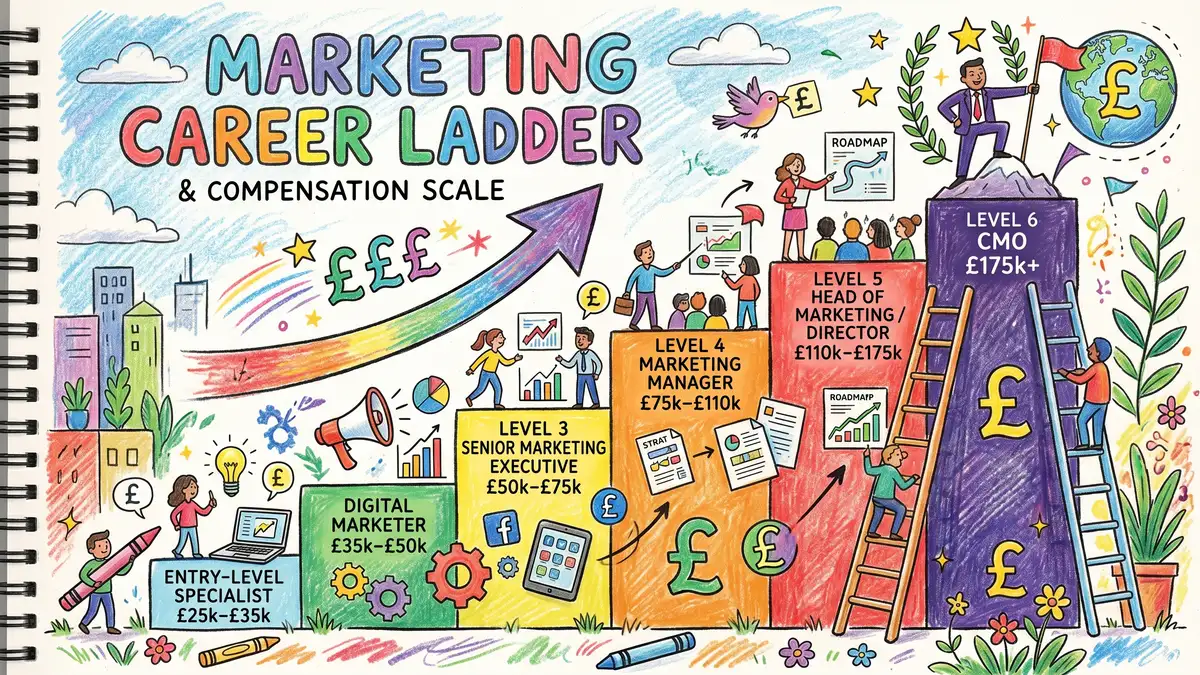
| Role | UK Average Salary | Range | Notes |
|---|---|---|---|
| Chief Marketing Officer | £187,500 | £125,000–£250,000 | Higher in SaaS/fintech; lower in services |
| VP / Director of Marketing | £150,000 | £100,000–£200,000 | London premium 10–15% |
| Head of Marketing | £105,000 | £90,000–£120,000 | Operational focus; reports to Director/VP |
| Product Marketing Manager | £70,000 | £55,000–£100,000 | Premium for direct revenue impact |
| Growth / Demand Gen Manager | £60,000 | £33,000–£79,000 | Wide range reflects experience variance |
| Content Marketing Manager | £70,000 | £45,000–£90,000 | Senior content roles surging to £161K |
| Marketing Ops Manager | £55,000 | £40,000–£75,000 | 10% YoY job posting growth (Robert Half) |
| Marketing Specialist (Entry) | £34,000 | £25,000–£50,000 | Entry-level; fewer roles as AI grows |
| AI Marketing Ops Lead | £140,000 | £130,000–£200,000 | 15–25% premium over non-AI equivalents |
Sources: Glassdoor UK 2025, Robert Half 2026 Salary Guide, LinkedIn 2026 Workforce Data
A key trend is the shift from volume-based content production to strategic content leadership. Meanwhile, entry-level content and coordination roles are contracting as AI handles routine production tasks. If you are building a team today, budget for fewer, more experienced hires rather than a larger junior team.
Watch for Salary Compression
Common mistake: Offering new hires premium salaries to attract talent without adjusting existing team members' pay — creating visible inequity where a new hire earns more than a 3-year veteran in the same role.
The fix: Run annual compa-ratio analysis comparing each employee's salary to their role's market rate. Budget for equity adjustments alongside new headcount. The cost of losing an experienced marketer to compression frustration far exceeds the cost of proactive salary alignment.
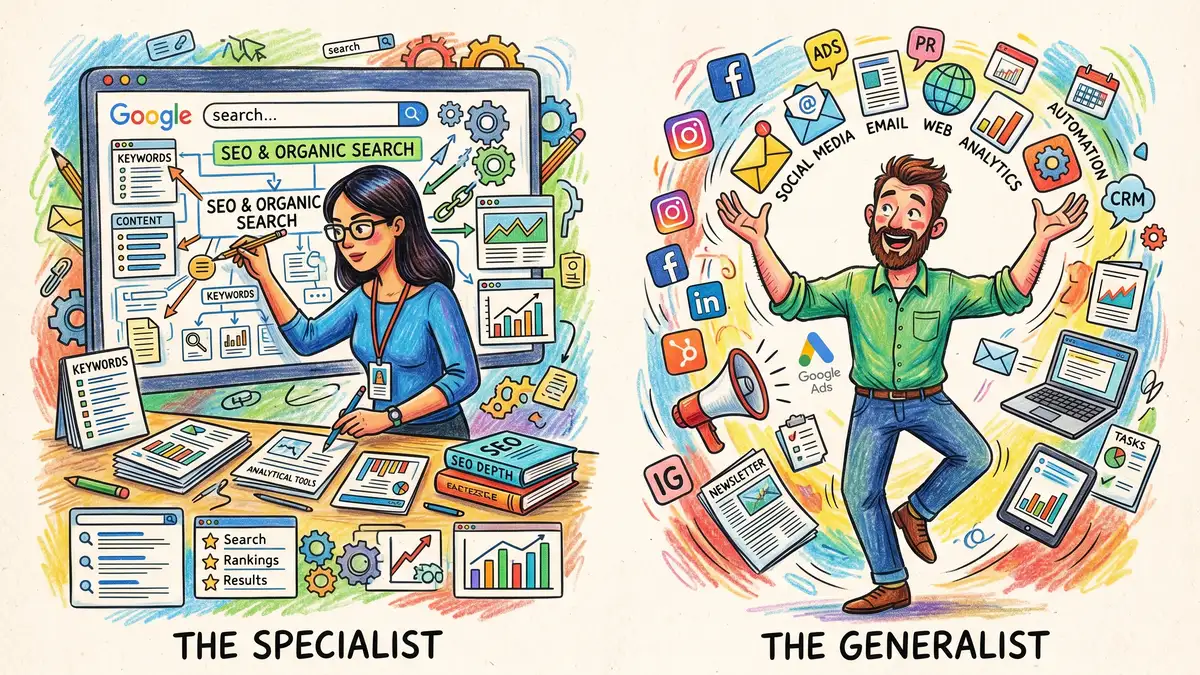
The generalist-versus-specialist question depends entirely on your stage. At startup (1–3 marketers), you need generalists who can write a blog post, launch a LinkedIn campaign, and build a HubSpot workflow in the same week. Hiring a specialist at this stage creates an expensive single point of capability whilst everything else languishes.
At growth stage (4–8 marketers), begin adding specialists in the channel driving the most pipeline. If organic search generates 40% of your leads, a dedicated SEO/content specialist delivers disproportionate returns. If paid media drives pipeline, hire a paid specialist before a content generalist. The key principle: specialize where the revenue evidence points, not where industry trends suggest.
At mid-market and above (9+ marketers), specialization is essential. Generalists at this stage become coordination bottlenecks — they know enough about every channel to be dangerous but not enough about any single channel to compete with focused competitors. Product-led SaaS companies should weight product marketing specialists at 22–25% of headcount. Enterprise sales-led companies should weight demand gen specialists at 32–35%.
AI is accelerating this shift. PwC's 2025 Global AI Jobs Barometer found that jobs requiring AI skills carried an average 56% wage premium over similar roles without them, up from 25% the year before. The implication for team structure is clear: fewer junior generalists executing routine tasks, more experienced specialists governing AI-augmented workflows. Marketing Mary is built for this model: it does the research and drafting, and your specialists decide what goes out.
Need help structuring your marketing workflows for a lean team?
See How Marketing Mary WorksThe order in which you hire determines whether your team builds on solid foundations or accumulates expensive capability gaps. Here is a five-stage hiring roadmap based on revenue milestones and the benchmarks from Gartner, Forrester, and LinkedIn talent data:
First Hire: Head of Marketing / Marketing Generalist
Owns strategy and execution. Defines GTM message, runs campaigns, manages website and analytics. Pair with a fractional CMO for strategic oversight. Supplement with freelance writers and contracted designers.
Hires 2–3: Pipeline Specialist + Content Producer
Add the specialist driving the most pipeline (demand gen or content, depending on your GTM). The third hire fills the other gap. Now you have strategy, pipeline, and content covered. Establish CRM, automation, and basic attribution before the next wave.
Hires 4–6: Marketing Ops + Product Marketing + Designer
Marketing Ops owns the tech stack, data quality, and reporting — critical for scaling. Product Marketing translates product capabilities into buyer messaging. A designer creates consistent visual assets. This is the growth-stage core team.
Hires 7–12: Functional Directors + Channel Specialists
Promote or hire Directors for demand gen, content, and ops. Add channel specialists: paid media, SEO, events, lifecycle email. The Head of Marketing shifts fully to strategic leadership. Establish weekly campaign reviews and monthly business reviews.
Hires 13–20+: AI Ops Lead + Field Marketing + Analytics
Add an AI Marketing Ops Lead to govern AI workflows. Field marketing managers embed with regional sales. A dedicated analytics team builds predictive models. Consider a Chief of Staff to manage cross-functional coordination at scale.
The key principle is systems before headcount. Establish CRM data architecture, lead scoring, campaign workflows, and attribution frameworks before each hiring wave. Companies that build systems during the growth stage scale smoothly to 20+. Those that skip this step experience exponential chaos. Our marketing automation guide provides the playbook for building these foundations.
Even well-designed teams develop structural problems that silently drain pipeline. The most dangerous red flags are the ones that feel invisible to leadership — the team produces output, campaigns run, revenue grows — but the team operates well below potential. Here are the four structural problems that most frequently stall growth in B2B companies:
Chronic Understaffing
Marketers working 50–60+ hour weeks, campaigns delayed or canceled due to bandwidth, new initiatives rejected because "we don't have capacity." The team never has time for strategic thinking — only tactical firefighting. Conduct a zero-based capacity audit to make the gap visible and quantifiable.
Skill-Gap Misalignment
The team is appropriately sized but lacks critical expertise for your GTM strategy. Pursuing account-based marketing with no ABM experience. Running a sophisticated MarTech stack with no technical ops capability. Fix: map strategy to required skills, hire for gaps, and upskill existing team on AI tools.
Reporting structure dysfunction creates a third category of problems. A CMO with 8–10 direct reports becomes a bottleneck — every question flows upward, every decision waits on availability. Above six or seven direct reports per leader, coordination tends to break down. The fix: use a RACI matrix to map decisions to roles, delegate tactical approvals within strategic guardrails, and aim for 4–5 direct reports per leader.
The fourth red flag is lack of governance. Duplicated tools across teams, inconsistent data definitions making cross-team reporting impossible, brand fragmentation as different pods evolve disparate visual languages. In the AI era, every unresolved weakness gets bigger — an AI content system that outputs inconsistent brand voice faster is merely magnifying an existing problem. Establish governance frameworks (data ownership, quality standards, decision rights) before adding headcount.
AI has not reduced marketing headcount as many predicted — it has reshaped team composition. Teams are using AI to produce more without a matching rise in headcount.
The shift hits entry-level roles hardest. Junior content, research, and coordination work that previously absorbed 1–2 full-time hires is now handled by a senior marketer plus AI agents. AI-literate marketing roles command a salary premium over equivalent non-AI positions (see the PwC finding above). New roles are emerging: Marketing AI Operations Lead, AI Content Quality Editor, Prompt and Workflow Designer, and Growth Engineer.
The practical implication: budget for fewer, more expensive hires. A senior content strategist governing AI-assisted workflows produces more output than two junior writers working manually — at roughly the same total cost. Explore our in-house vs agency decision guide to see how AI-augmented hybrid models compare on total cost of ownership.
The Bottom Line
AI is not replacing marketers — it is replacing marketing team structures. The model of a large generalist team is giving way to a smaller group of specialists augmented by AI agents. Companies that restructure around this reality can run leaner teams without losing output. Those that do not will overspend on talent whilst underperforming on pipeline.
Benchmarking your team against industry data reveals whether you are appropriately staffed, fairly compensated, and correctly structured for your revenue stage. Use these benchmarks to audit your current team:
| Benchmark | Target Range | What It Tells You |
|---|---|---|
| Team size vs revenue | 3 (£1-10M), 11 (£10-50M), 26 (£50-250M) | Below median suggests understaffing; above suggests potential inefficiency |
| Fully loaded cost per marketer | Start from the UK salary table above and add on-costs | Below range risks underspending on tools/training; above suggests bloated overhead |
| Marketing spend as % of revenue | 6.4% (B2B product), 9.0% (B2B services) | US averages from The CMO Survey 2025; smaller companies tend to spend a higher share |
| Tools as % of loaded cost | Track year over year | Watch for tool costs growing faster than headcount |
| Direct reports per leader | 4–5 | Above 6–7, coordination tends to break down |
| B2B vs B2C team size | B2B usually runs larger | Multi-stakeholder buying and longer sales cycles require more field-facing roles |
Sources: Gartner 2026 Marketing Survey, The CMO Survey 2025
Download our org chart templates and roles guide below to map these benchmarks against your current team. If you find yourself more than 20% below the median team size for your revenue band, that is a strong signal to build the business case for additional headcount — our marketing dashboard template can help you present the data to finance leadership.
The VP of Marketing (in UK companies more often the Marketing Director) sits at the top of the marketing department and reports to the CMO where one exists, otherwise directly to the CEO. Every marketing function — demand generation, content, product marketing, brand and marketing operations — rolls up to this role.
A Head of Growth usually sits inside marketing, reporting to the CMO or VP of Marketing. In product-led companies the role can instead head a standalone growth team alongside product. The deciding factor is whether growth is driven mainly by acquisition campaigns (marketing) or by in-product experimentation (product).
The median B2B marketing team at £10–50 million revenue is 11 marketers, with a typical range of 7–18. At the lower end of this revenue band (£10–15M), expect 4–8 marketers: a Head of Marketing, Demand Gen Manager, Content Lead, and Marketing Ops Coordinator, supplemented by freelancers or agencies for design and specialist channels.
Your first marketing hire should be a Head of Marketing or Marketing Generalist who can own strategy and execution simultaneously — someone comfortable with ambiguity who has demonstrated experience taking a product from unknown to known. Pair them with a fractional CMO for strategic guidance and freelance specialists for content and design.
Start from the UK salary benchmarks above, then add employer National Insurance (15% above £5,000 since April 2025), pension (minimum 3%), tools and training. Use our downloadable TCO calculator in the in-house vs agency guide to model your specific costs.
AI is reshaping rather than replacing marketing teams. Existing teams are producing more with AI tools. Entry-level generalist roles are contracting, whilst senior specialist and AI operations roles are expanding.
Restructure when you see these signals: chronic understaffing (50–60 hour weeks, canceled campaigns), the Head of Marketing spending more than 50% of time on execution rather than strategy, more than 6–7 direct reports per leader, skill gaps preventing execution of your GTM strategy, or when revenue crosses a band threshold (£10M, £30M, £100M) that demands a structural rebuild.
See what Mary finds on your website.
Join the early-adopter list and be one of the first to try Mary on your own website.
Plans from Free to Enterprise · pricing to be confirmed
Sources: Gartner 2026 Marketing Survey, The CMO Survey 2025, Robert Half 2026 Salary Guide, Glassdoor UK 2025, PwC 2025 Global AI Jobs Barometer, LinkedIn 2026 Workforce Data, HMRC Employer NI Guidance 2025, CIPD UK 2026
Clwyd Probert
Founder, Marketing Mary
Clwyd Probert is the founder of Marketing Mary, an evidence-first persona intelligence platform for B2B marketing, and CEO of Whitehat, a London-based SEO and inbound marketing agency and HubSpot Diamond Solutions Partner.
Planning a lean team?
See how Marketing Mary works Clwyd Probert: Sep 30, 2026, 8:25:00 PM
An evidence-graded buyer persona is a buyer persona in which every claim carries a label saying where it came from: first-party evidence (the...
 Clwyd Probert: Sep 9, 2026, 11:58:11 PM
Our own Search Console tells this story: impressions up 53% and clicks down 6% in the 28 days to September 6, 2026, compared with the 28 days before,...
 Clwyd Probert: Aug 25, 2026, 10:16:09 AM
You can find HubSpot's credit rates. You can find your monthly allowance. What you cannot easily find is the sentence that connects them — so most...
 Clwyd Probert : May 5, 2026, 10:00:00 AM
We compared AI buyer persona tools for 2026, including HubSpot, Delve AI and UXPressia, on research depth, integration, B2B fit and price.
 Clwyd Probert : Apr 10, 2026, 9:00:00 AM
Free marketing plan template for 2026 in Excel and PDF. Includes SOSTAC framework, UK B2B budget benchmarks, step-by-step guide, and worked examples.
 Clwyd Probert : Mar 26, 2026, 9:00:00 AM
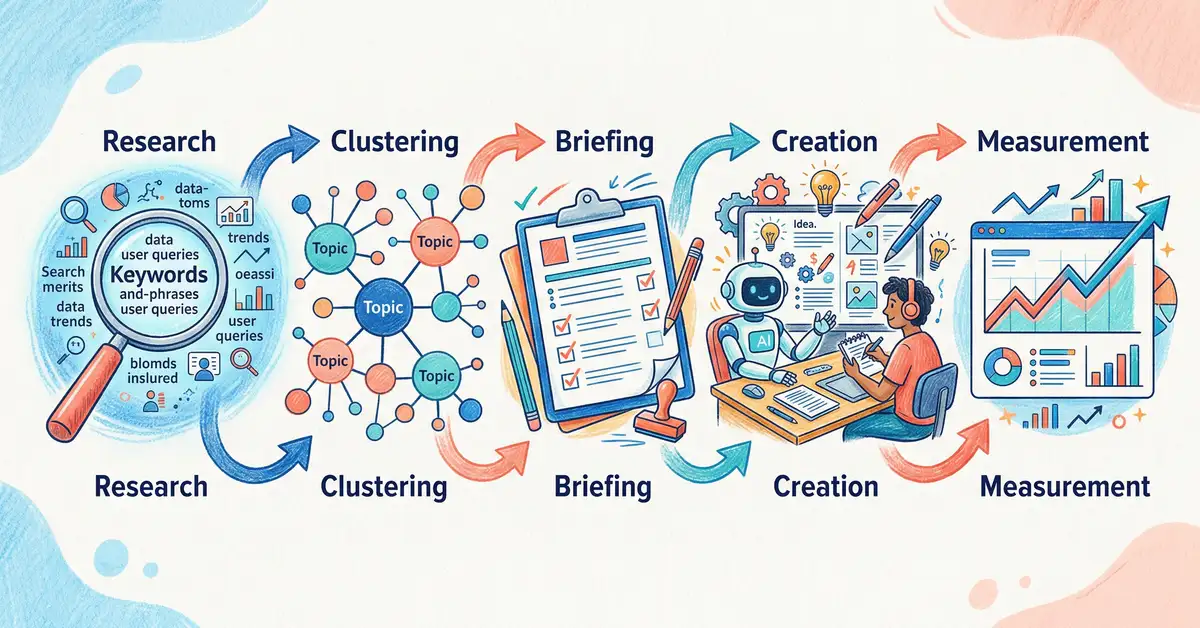
Build an AI content strategy, from research and clustering to briefs, creation and measurement, with a five-stage framework.